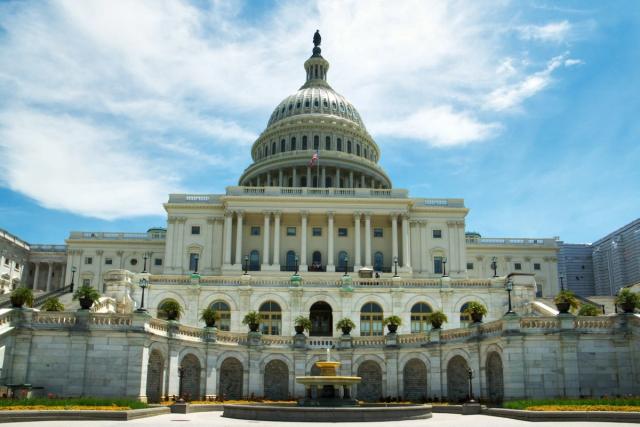
Federal decision
Albert Roberson
Founder & CEO
Updates from the CEO · Read Albert Roberson’s latest update →
404
The page you are looking for does not exist or has moved. Let us get you back on track.
Training
Purchase →A leading civil rights compliance practice for colleges, PK–12 districts, and workplaces. Senior fractional coordinators, neutral investigations, certified training, and OnePointe, our case-management platform, brought together under one standard. The stakes are high. The standard should be higher.
The frameworks we work in
Fractional Coordinator, Inc.
Oregon SquareT: (503) 395-0687
F: (503) 395-0815
E: hello@fractionalcoordinator.com
Monday–Friday, 8am–6pm
Our home base sits in Oregon Square on NE Holladay Street, in Portland’s Lloyd District, a short walk from the Rose Quarter.
From here, our investigators, fractional coordinators, and trainers partner with colleges, PK–12 districts, and workplaces across the country, building civil rights processes that protect people and hold up under audit.
Call our office at (503) 395-0687, or write to hello@fractionalcoordinator.com.
Journalists and media inquiries: our press page has bios, brand assets, and the fastest route to a quote.
Your engagements, invoices, documents, and the help desk all live in the client portal.
Members of the Knowledge Hub will also find their briefings, templates, and course registration inside.
Share a few details and the right team will follow up. Everything here is confidential.
Reach the right team directly, from a first conversation to an active matter that needs to hold up under audit.
Certified training and events on Title IX, Title VI, ADA, and Title VII, built to hold up under audit. Filter by topic, or browse by month.
Workshops, flagship programs, certifications, and cohort bootcamps. Filter by topic.
Session registration is handled through Luma. Privacy Policy Member discounts are applied in the client portal on the basis of your membership level. Programs marked Members only require a Knowledge Hub membership. All other sessions are open to all practitioners, members and non members alike.
Intensive certification for investigators ready to move past foundations: evidence handling, credibility, trauma informed interviews, and defensible reports.
Online (Zoom)
Dates Jul 28, 2026 · 8:00 AM–12:00 PM PT
A working session on interview practice that respects parties and produces a usable record.
Online (Zoom)
Dates Dec 14, 2026 · 11:00 AM–2:30 PM PT
A focused session on intake, assessment, and response when a Title VI complaint arrives.
Online (Zoom)
Dates Jan 12, 2027 · 2:00 PM–3:00 PM PT
Full certification for practitioners holding the Title IX Coordinator seat, delivered in person.
Portland, OR
Dates Jan 25–29, 2027 · 8:00 AM–3:30 PM PT
A two hour session on trauma-informed interviewing: how trauma shapes memory and behavior, evidence-based preparation and technique, navigating difficult interview dynamics, and balancing compassion with impartial fact-finding across Title IX, civil rights, HR, and student conduct matters.
Online (Zoom)
Dates Feb 23, 2027 · 2 hours
A one hour overview of the confidential advocate role: confidentiality versus mandatory reporting, referral practice, and how confidential resources work alongside Title IX, HR, ADA, and student conduct in a survivor centered response.
Online (Zoom)
Dates Apr 13, 2027 · 12:00 PM–1:00 PM PT
Interview technique for investigators working with parties in distress.
Online (Zoom)
Dates Feb 23, 2027 · 9:00 AM–12:30 PM PT
A multi-day intensive for practitioners past the basics and ready for complex casework.
Online (Zoom)
Dates Mar 9–11, 2027 · 9:00 AM–4:00 PM PT
A short course on handling Title VI complaints under current enforcement priorities.
Online (Zoom)
Dates May 12, 2027 · 1:00 PM–2:00 PM PT
A working session on interview practice that respects parties and produces a usable record.
Online (Zoom)
Dates May 25, 2027 · 9:00 AM–2:00 PM PT
What mandatory reporters must do, and the mistakes that create liability.
Online (Zoom)
Dates Jun 7, 2027 · 11:30 AM–1:00 PM PT
Findings memos that hold up: structure, evidentiary reasoning, and clear determinations.
Online (Zoom)
Dates Jun 21, 2027 · 11:00 AM–2:00 PM PT
Cohort based ADA and Section 504 coordinator certification on a summer schedule, western time zones.
Online (Zoom)
Dates Jul 12–15, 2027 · 8:00 AM–4:00 PM PT
Cohort based ADA and Section 504 coordinator certification on a summer schedule, eastern time zones.
Online (Zoom)
Dates Jul 19–22, 2027 · 8:00 AM–4:00 PM PT
Certification track for practitioners carrying Title VI responsibilities.
Online (Zoom)
Dates Jul 19–20, 2027 · 11:00 AM–2:30 PM PT
Running the interactive process correctly, from request through documentation.
Online (Zoom)
Dates Jul 21, 2027 · 12:00 PM–2:00 PM PT
Cohort based Title IX Coordinator certification on a fall schedule, western time zones.
Online (Zoom)
Dates Aug 16–20, 2027 · 8:00 AM–4:00 PM PT
Practical framework for selecting, documenting, and defending supportive measures.
Online (Zoom)
Dates Aug 18, 2027 · 12:30 PM–1:30 PM PT
Certification for investigators handling Title IX matters, interviews through findings.
Online (Zoom)
Dates Aug 24–25, 2027 · 9:00 AM–4:00 PM PT
Certification for investigators handling Title IX matters, interviews through findings.
Online (Zoom)
Dates Sep 8–9, 2027 · 9:00 AM–4:00 PM PT
Cohort based Title IX Coordinator certification on a fall schedule, eastern time zones.
Online (Zoom)
Dates Sep 13–17, 2027 · 8:00 AM–4:00 PM ET
Applying ADA and Section 504 obligations in PK-12 districts, accommodations through grievance.
Online (Zoom)
Dates Sep 14, 2027 · 10:00 AM–11:00 AM PT
For coordinators new to the role. Regulatory framework, intake procedures, supportive measures, basic investigation, hearing logistics.
40 hrs · 5 days · Virtual
Starts Nov 24, 2026
Advanced topics for experienced coordinators. Complex multi-respondent matters, Title VI overlap, interim measures litigation, OCR investigations.
32 hrs · 4 days · Hybrid
Starts Jul 13, 2027
For investigators in postsecondary contexts. Trauma-informed interviewing, evidence collection, credibility analysis, report drafting.
2 days · 08:00–13:30 PT · Virtual
Dates Dec 22–23, 2026
For faculty, deans, and administrators serving as decision-makers in formal grievance processes. Standards of proof, weighing evidence, writing findings.
16 hrs · 2 days · Virtual
Starts Apr 22, 2027
Cross-jurisdictional investigation skills for HR, EEO, and Title IX teams. The shared foundations across all three civil rights regimes.
16 hrs · 2 days · Virtual
Dates Mar 23–24, 2027
For ADA Coordinators and disability services administrators. Reasonable accommodation analysis, interactive process, program access.
32 hrs · 4 days · Virtual / Hybrid
Dates Feb 8–11, 2027
For campus safety, security, and student affairs staff. Crime classification, reporting, daily log maintenance, ASR preparation.
16 hrs · 2 days · Virtual
Dates Aug 10, 2027 · 8:00 AM–4:30 PM PT
Hands-on workshop focused entirely on the investigation report itself. Structure, voice, evidentiary citation, credibility analysis, conclusions.
16 hrs · 2 days · Virtual
Starts May 25, 2027
Full certification track for Title IX Coordinators, framework through recordkeeping.
Certification · Multi-day · Virtual
Starts Sep 13, 2027
Certification track for Title VI Coordinators: intake, hostile environment, remedies, OCR.
Certification · Multi-day · Virtual
Starts Apr 13, 2027
Certification track for ADA and Section 504 Coordinators: accommodations to grievance.
Certification · Multi-day · Virtual
Starts Jun 10, 2027
Certification in defensible investigative report writing: structure to conclusions.
Certification · Multi-day · Virtual
Dates Feb 17–18, 2027
Cohort introduction to civil rights compliance fundamentals across Title IX, VI, ADA, and Clery.
Bootcamp · Multi-day · Virtual
Dates May 4–6, 2027
Cohort bootcamp deepening practical skills across intake, investigation, and coordination.
Bootcamp · Multi-day · Virtual
Dates Mar 9–11, 2027
Advanced cohort bootcamp for complex, high-stakes matters and defensibility on review.
Bootcamp · Multi-day · Virtual
Dates Sep 28–Oct 1, 2027
Twice a year we gather practitioners for a few days of deep work, peer exchange, and room to think, away from the caseload.
Practical thinking on civil rights compliance for colleges, PK–12 districts, and workplaces, written to be used, not filed away.
From the CEO
Letters and notes from our Founder and CEO, Albert Roberson, on federal and state decisions and the pending matters worth watching.
The 2020 regulations govern, April’s rescissions and athletics enforcement reshape the posture, and 2024-era language left in your procedures is a compliance problem, not a style problem.
Read the letter →Enforcement has narrowed in focus and sharpened in consequence: shared ancestry complaints are the center of gravity, and notice plus inadequate response is the fact pattern that produces findings.
Read the letter →The DOJ moved the Title II web accessibility deadline to 2027 for nearly all public universities. The underlying obligations did not move, and neither did Section 504.
Read the letter →The EEOC’s National Enforcement Plan names DEI programs as a priority, deprioritizes disparate impact, and pulls the affirmative action guidance floor. The program inventory can no longer wait.
Read the letter →Hazing statistics enter the Annual Security Report this October. The transparency report was the warm-up; the ASR cycle is where the data infrastructure gets tested.
Read the letter →Half of OCR was laid off, recalled, and the actions rescinded, at a cost the GAO put near thirty eight million dollars. Enforcement volatility is not compliance relief.
Read the letter →Federal decision
Albert Roberson
Founder & CEO
Policy
Why documentation and process discipline, not good intentions, are what survive an OCR review.
Most institutions don’t lose civil rights cases because they acted in bad faith. They lose because, months later, they can’t show what they did, when they did it, or why. “Audit-ready” is the discipline of building that record while the work is happening, not reconstructing it after a complaint lands.
Scenario: A district resolves a Title IX complaint quickly and, by every account, fairly. A year later, the Office for Civil Rights opens a review. The coordinator has moved on, the notes were kept informally, and the timeline is scattered across three inboxes. The outcome was right. The record can’t prove it.
This is the quiet way most programs fail, not in the decision, but in what survives it. When a matter is examined after the fact, by OCR, by a court, or simply by the next administrator to inherit the file, no one in the room witnessed the care that went into it. They see what was written down. If that’s thin, the care is invisible, and invisible care is hard to distinguish from neglect.
Every framework we work in, Title IX, Title VI, Title VII, Section 504, ultimately asks the same question after the fact: did the institution follow a fair, consistent process, and can it show that it did? Good faith is assumed of no one. The burden is on the institution to demonstrate it, and demonstration is a documentation problem before it is anything else.
A right outcome with no record is a case you can still lose.
That’s not an argument for over-documenting. It’s an argument for documenting the things that carry weight: notice, supportive measures, the reasons behind each significant decision, and the dates all of it happened.
Three habits separate audit-ready programs from the rest. The first is contemporaneous notes, written while memory is fresh, not weeks later when a complaint forces reconstruction. The second is a single source of truth, so the timeline lives in one place instead of scattered across people who may not be there when it matters. The third is decisions tied to a standard: every consequential choice should point back to the policy or regulation that authorizes it, so a reviewer can trace the reasoning rather than take it on faith.
Audit-readiness fails when it curdles into bureaucracy, box-checking that exhausts the people doing the actual work. The goal isn’t more paper; it’s the right paper, captured once, at the moment it’s created. Done well, it makes the work faster, not slower, because no one is hunting for what happened six months ago.
You can’t predict which matter will be the one that gets reviewed, and that’s exactly the point. The institutions that hold up under scrutiny are the ones that treated every file as if it would be the one. Not because they expected trouble, but because a fair process and a provable process should be the same thing.
We work in three modes, often together, toward one standard: civil rights processes and outcomes that hold up under audit.
Neutral, trauma-informed, and defensible. We handle complaints from intake and notice through a written report built to survive OCR review or appeal, across Title IX, Title VI, Title VII, ADA/504, and Clery matters.
Senior civil rights coordination without the full-time overhead, coverage during a coordinator’s leave or departure, capacity during a surge, or a standing partnership for institutions that can’t justify a full-time role but can’t afford to improvise.
Training that proves competence, not just attendance. Certification, framework workshops, and annual refreshers, each with an assessment and a credential your program can point to when it’s challenged.
When a matter reaches litigation or a contested hearing, our practitioners testify to the standard of care. Retained by plaintiffs and defendants alike, with opinions built to survive cross-examination.
A practitioner’s firm that sets the standard it holds institutions to. We’ve spent over a decade inside the places we now serve, colleges, PK–12 districts, and workplaces, where civil rights compliance is hardest and the stakes are highest. It’s why institutions bring us their most consequential matters, and why we partner with each on its own terms.
Colleges and universities carry some of the most complex civil rights obligations anywhere, Title IX, Title VI, Clery, and ADA/504 running at once, often across the same matter. We bring senior judgment to intake, investigations, and program design that holds up under federal review.
Districts balance Section 504, Title VI, and Title IX responsibilities for both students and staff, usually without a full-time civil rights office. We provide the expertise a full-time role would, fractionally, and build processes families and staff can trust.
Employers meeting Title VII and ADA obligations need investigations that are fair to everyone involved and defensible if challenged, and managers trained to avoid the retaliation claims that so often follow. We handle both.
Careers
Apply now →Do work that protects people, strengthens institutions, and stands up to scrutiny. We’re a small, senior team trusted to lead complex civil rights compliance with judgment, rigor, and care.
Experienced practitioners who’ve done this work inside institutions: investigators, coordinators, and trainers who care as much about a defensible record as a fair outcome. We value judgment over credentials, though the credentials help.
Fractional and project-based, remote-first from our Portland base, with real ownership of the matters you take on. Senior people, small caseloads, high standards, not a volume shop.
We don’t always have a posting up, but we’re always glad to hear from practitioners who’d raise our standard. Tell us what you do and how you’d want to work with us.
Current openings across our investigations, coordination, and training practice. Don’t see a fit? Introduce yourself at hello@fractionalcoordinator.com.
Senior work without the grind of a volume shop, and the support to do it well.
Salaried and fractional roles, paid for the responsibility you carry, not the hours you log.
Work from anywhere, anchored to our Portland base. We coordinate across time zones, not commutes.
Medical, dental, and vision for full-time staff, with an eye to the real weight of this work.
Flexible, generous paid time off, and small caseloads so you can actually take it.
We’re a learning institute; we invest in yours, from continuing education to conference support.
A retirement plan with an employer contribution to help you plan past the next matter.
Senior practitioners with deep Title IX, Title VI, ADA, or Title VII experience can email recruitment@fractionalcoordinator.com with a CV and a brief note. We respond within two weeks.
Most of our staff came to us through years of professional relationship. The fastest path in is to engage with the Fractional Digest, attend our convenings, and let us see your practitioner work over time.
If you’re a practitioner who wants to contribute pro-bono on specific matters or join our practitioner advisory council, write to us at probono@fractionalcoordinator.com with a brief description of your interest area.
When you join Fractional Coordinator, you join a team that believes good process protects people. Our benefits and resources support you to find balance and do the best work of your career, and our practitioners will sharpen your craft in rooms where the stakes are real. Together we help institutions respond with intention instead of reacting under pressure, and we deliver work that holds up to scrutiny. Apply today to shape how this profession is practiced, for yourself, for the institutions we serve, and for the people they protect.
Fractional Coordinator strives to create an accessible and inclusive experience for every candidate. If you need a reasonable accommodation during the application or recruiting process, write to accessibility@fractionalcoordinator.com with the subject line Accommodation request and we will work with you promptly. You can read more about our commitments in our accessibility statement.
Please see our Privacy policy for information about how we handle your personal data during recruiting. Selection and hiring decisions are always made by people.
Fractional Coordinator is an equal opportunity employer and maintains a policy of non-discrimination with all employees and applicants for employment. What does that mean exactly? It means that we believe in equality for all, and we believe we can help lead the path to equality in part by building a workplace that is inclusive and free from discrimination. Know your rights: workplace discrimination is illegal.
Every employee and applicant is assessed on the basis of merit, competence, and qualifications, without regard to race, religion, color, national origin, sex, sexual orientation, gender expression or identity, transgender status, age, disability, veteran or marital status, political viewpoint, or other classifications protected by law. This policy applies to current and prospective employees at every stage of the employment journey. It also applies to recruiting, hiring, job assignment, compensation, promotion, benefits, training, assessment of job performance, discipline, termination, and everything in between. Recruiting, hiring, and promotion decisions at Fractional Coordinator are fair and based on merit. The same goes for compensation, benefits, transfers, and education.
A practitioner’s firm. The people who do the work have done it inside the institutions we serve, as coordinators, investigators, and administrators.
Try searching for
No team members match your search.
LL.B., LL.M. · Founder & CEO
Founder and CEO. Over a decade as a civil rights compliance practitioner inside higher education and PK–12 institutions.
COO & Communications Director
Leads operations and communications, keeping engagements running smoothly and the standard consistent across every matter.
J.D., M.P.A. · Chief of Investigations
Leads the firm’s investigative practice across Title IX, Title VI, Title VII, and ADA matters, built to hold up on review.
Governance and strategic direction for Fractional Coordinator.
Service
Neutral, trauma-informed investigations that hold up under review, from intake through a defensible written report.
Accepting new matters · 30-day intake
When a civil rights complaint lands, the decision matters, but so does whether you can show, months later, that the process was fair. We conduct investigations that answer both: a sound outcome, and a record built to survive OCR review, a hearing, or an appeal.
We work across Title IX, Title VI, Title VII, ADA/504, and Clery matters, as a neutral third party or as an extension of your team. Either way, the standard is the same.
From routine to exceptionally complex.
Sexual harassment, sexual assault, dating violence, and discrimination cases. Higher education (postsecondary regulations) and workplace (Title VII or state-equivalent). We run intake through findings memo, with full evidentiary review.
Typical duration 4–8 weeks · Lead investigator Whitney Kenner-Jones or Jordan Reyes
Race, color, and national origin discrimination, including matters involving alleged campus antisemitism, Islamophobia, and other forms of identity-based hostility. We are particularly experienced with the post-October-2023 wave of Title VI matters in higher education.
Typical duration 6–12 weeks · Specialty Multi-respondent, climate-based
Disability discrimination, denial of reasonable accommodations, and accessibility-related complaints. We handle both individual cases and systemic reviews, including digital accessibility audits and program access analyses.
Typical duration 3–10 weeks · Lead Diana Aboubakar
Title IX in K-12 has its own framework: younger complainants, mandatory reporting complexity, and parental involvement. Our K-12 practice handles cases for districts ranging from rural single-school operations to large urban systems.
Typical duration 4–8 weeks · Specialty Trauma-informed, age-appropriate
Senior personnel investigations, faculty, executives, and board members, where in-house counsel needs neutrality from the institution itself. Includes harassment, retaliation, and conduct-based matters with collateral employment implications.
Typical duration 6–14 weeks · Discretion Sealed reports, NDAs available
Cases that span multiple campuses or organizations: visiting students, athletic conferences, joint programs, or shared employees. We coordinate across the involved entities and produce a single coherent report.
Typical duration 8–16 weeks · Complexity High; senior team only
We assess what was reported, which framework governs, and what the institution’s obligations are before anything else moves.
Careful, structured interviews that treat everyone with dignity and still build a reliable, testable account.
We weigh the evidence against the correct standard of proof and reach findings a reviewer can trace.
A clear, well-documented written report, the artifact that survives scrutiny long after memories fade.
Honest about fees.
For consultations, second opinions, and discrete tasks that do not warrant a full engagement. Billed hourly with monthly statements.
Title IX, Title VII, and ADA matters with 1–2 complainants and 1–2 respondents. Fixed-fee engagement covering intake through final report. Most of our matters fall in this range.
Multi-respondent, multi-institution, or matters with extensive document review (corporate records, communications archives). Capped hourly with a not-to-exceed ceiling.
Senior personnel, board-level, and matters with significant collateral implications. Hourly engagements with weekly status reports. References available on request.
All fees include direct expenses up to 5% of the engagement value. Travel for on-site interviews is billed at cost without markup. Rush engagements, started within 7 days of intake, carry a 20% surcharge.
For the live hearing stage that postsecondary Title IX matters require.
Trained, conflict checked decision-makers who run the live hearing, rule on relevance in real time, and write determinations that connect the evidence to the findings.
Where a party arrives without an advisor, we provide one, as the 2020 regulations require, briefed on the record and committed to respectful questioning.
Independent appellate review on the grounds the rules permit, closed with a written decision.
Scheduling, remote participation technology, exhibits, the recording, and the procedural script, managed end to end so the panel can focus on the record.
Staffed per matter and scoped with your engagement lead, with every role conflict checked against prior work for your institution. Institutions that prefer to keep these roles in-house can train them through the Learning Institute.
Initial conversations are free and confidential. We do a conflict screen and let you know within 48 hours whether we can take the matter.
Service
Senior civil rights coordination on the days you need it, coverage, capacity, or a standing partnership.
Not every institution needs a full-time Title IX or civil rights coordinator. Many need senior expertise reliably, during a coordinator’s leave, a surge in matters, a complex case, or simply the ordinary weeks when a seasoned hand makes everything cleaner.
A fractional coordinator is an experienced practitioner embedded in your institution part-time, carrying real responsibility, not a consultant who advises from the outside and leaves. The work is owned, the record is kept, and the standard matches a full-time hire’s.
We hold the role during a coordinator’s leave or departure, so nothing slips between hires.
Extra senior hands when case volume spikes beyond what your team can absorb.
We build or refresh the processes, policies, and workflows that keep you compliant by default.
We get your files, timelines, and documentation into shape before anyone asks to see them.
A focused intake call, a conflict screen, and a written scope with clear coverage hours and reporting lines.
Your fractional coordinator learns the caseload, calendars, and systems, and takes the intake queue without a gap.
Cases move, deadlines hold, and leadership receives a standing report. We work inside your policies, not around them.
When a permanent hire lands, we train them on the live caseload and leave documentation a successor can run.
Pricing for fractional roles.
8–16 hours per week. Most common engagement. Single domain, typically Title IX. Senior practitioner with 5+ years of experience.
12–24 hours per week. Holding the formal Title IX or Title VI Coordinator role. Senior practitioner with 7+ years and prior coordinator experience.
16–24 hours per week. Multi-domain leadership across Title IX, Title VI, and ADA. Senior practitioner with 10+ years and director-level experience.
Engagements are quarterly with a 60-day exit notice. We do not charge separately for case work, training delivery, or policy reviews handled within the contracted hours. Travel for on-site presence, where requested, is billed separately at cost.
Service
Certification, workshops, and refreshers that prove competence, not just attendance.
Plenty of people have “been trained.” Far fewer can prove they met a standard. When a matter is challenged, that difference, between a sign-in sheet and a credential, is one a reviewer notices.
Our training runs through the Learning Institute: certification courses with real assessments, framework-specific workshops, and annual refreshers that keep your people current as the law moves.
Three tiers of training.
Multi-day intensive programs with assessment and a 3-year certification period. For practitioners stepping into Title IX, Title VI, or ADA coordinator roles, or seeking to formalize existing expertise.
Format Virtual / Hybrid · 16–40 hours · Tuition $1,200–$3,800
Three-tier intensive bootcamps for practitioners at different career stages. Designed to build hands-on capacity quickly: investigation skills, decision-making frameworks, report writing.
Format Virtual / Hybrid · 24 hours · Tuition $1,500–$4,800
Five-day on-ground retreats at our two flagship locations. Cohort-based, immersive, with extensive case-based practice. Limited to 24 participants per retreat for the close-quarters mentorship that makes them work.
Format On-ground · 5 days · 40 hours · Tuition $5,400–$6,800
Workshops and custom training.
2-hour and half-day virtual workshops on specific topics: handling Title VI complaints, mandatory reporter best practices, conducting respectful interviews, and writing defensible findings memos. Open enrollment, monthly.
Per person $185–$425 per workshop · Group rates 5+ from the same institution
On-site or virtual training built specifically for your institution. We have delivered custom programs for university systems, K-12 districts, and corporate clients ranging from 12-person teams to 800-person rollouts.
Pricing From $8,500 per training day · Lead time 6 weeks for design, 2 for delivery
Pick the certification, bootcamp, or retreat that matches the role. Our team can help you place practitioners at the right level.
Live instruction and case-based practice, taught by people who carry active caseloads.
Competence is demonstrated, not attended. Every certification ends with an assessment that has to be earned.
A 3-year certification period, with refreshers available to keep your team current as the law moves.
Browse every cohort, certification, and flagship program in one place.
Visit the Learning Institute →Beyond the classroom, our senior practitioners also serve as expert witnesses in litigation and campus proceedings. Explore expert witness services →
Sector
Some of the most complex civil rights obligations anywhere, Title IX, Title VI, Clery, and ADA/504, often on the same matter.
Colleges and universities carry overlapping obligations that rarely stay in their own lanes. A single incident can trigger Title IX process, a Clery timely warning, and a Title VI question at once, each on its own clock.
We bring senior judgment to that complexity: neutral investigations, fractional coordination, and training built for institutions that answer to federal reviewers and their own communities alike.
Neutral, defensible investigations across the frameworks higher ed lives with.
Senior Title IX and civil rights coordination, full-time in expertise, if not in hours.
Investigator certification and role-specific workshops through the Learning Institute.
Documentation and process discipline that holds up under OCR review.
The regulatory ground under higher education has shifted repeatedly and settled, for now, in a demanding place. The 2020 Title IX regulations govern again, live hearings and cross examination included. Title VI enforcement has concentrated on shared ancestry harassment and on eligibility criteria in scholarships and programs, with federal funding itself as the lever. The Clery Act has been renamed and expanded, and hazing statistics now flow into the Annual Security Report.
Meanwhile the enforcement apparatus itself is in flux: thin agency capacity one quarter, coordinated multi office investigations the next. None of that changes the underlying obligations, and private litigation continues regardless of agency staffing. The institutions that fare well are the ones whose intake, process, and documentation would satisfy a reviewer who arrives years later with hindsight.
That is the posture we build with campuses: not reaction to the loudest headline, but a process that holds up under whichever reviewer arrives next.
A fractional Deputy or full seat Coordinator embedded with your team, carrying intake, supportive measures, and process management through the academic year.
Typical model Deputy Coordinator · Cadence 8–16 hours per week
Coverage during a coordinator search, a leave, or hearing season, with a senior practitioner who can take a caseload on day one and hand it back documented.
Typical duration One to three terms · Start Within two weeks
External investigations for conflicted or high profile matters, audit readiness reviews, and annual training cycles, scoped and priced per engagement.
Typical model Fixed fee scope · Lead Senior practitioner
Sector
Section 504, Title VI, and Title IX for students and staff, usually without a full-time civil rights office.
Districts balance real civil rights obligations for both students and staff, often with no dedicated compliance role and limited bandwidth. Section 504 and ADA, Title VI, and Title IX all apply, and families are watching.
We provide the expertise a full-time role would, fractionally, and build grievance processes that students, families, and staff can trust, and that survive review.
Compliant accommodation and grievance processes that hold up under OCR review.
Neutral investigations for Title IX, Title VI, and disability matters involving students or staff.
Senior coordination without adding a full-time position to the budget.
Practical training for administrators and staff who receive and respond to concerns.
Title IX in PK–12 runs on the same 2020 regulations as higher education, but nothing about the work is the same: younger complainants, mandatory reporting obligations layered on top of civil rights process, and parents as participants with rights of their own.
Federal attention has followed the districts. Enforcement has paired Title IX findings with student privacy findings in single coordinated investigations, and the collision between state law and federal enforcement over athletics has put districts in the middle of disputes they did not choose. A small central office can hold formal responsibility for all of it with no one whose full time job is compliance.
That is the gap we fill: senior practitioners who know the PK–12 framework specifically, age appropriate and trauma informed practice, and documentation that protects the district when the matter is reviewed later.
A senior coordinator carrying the Title IX or 504 function for one district, or shared across a consortium of small districts that cannot each staff the role.
Typical model Shared or single district · Cadence 8–16 hours per week
External investigations run with age appropriate interviewing, mandatory reporting awareness, and clear communication with families throughout.
Typical duration 4–8 weeks · Practice Trauma informed
504 and Title IX process redesign, board and administrator training, and mandatory reporter workshops that reflect how schools actually operate.
Typical model Fixed fee scope · Delivery On site or virtual
Sector
Title VII and ADA obligations, fair, defensible investigations and managers trained to avoid the claims that follow.
Employers meeting Title VII and ADA obligations need investigations that are fair to everyone involved and defensible if challenged, and managers who won’t turn a resolved complaint into a retaliation claim.
We handle both: neutral workplace investigations built to hold up, and training that gives managers and HR the judgment to respond well the first time.
Neutral, trauma-informed investigations of harassment, discrimination, and retaliation complaints.
Practical training on receiving complaints, avoiding retaliation, and documenting decisions.
Grievance and reporting processes that are fair, consistent, and provable.
Senior capacity for complex matters or periods of elevated volume.
Employment compliance has had its clearest reset in years. The EEOC’s National Enforcement Plan names discrimination tied to DEI initiatives among its priorities, treats retaliation as a standalone enforcement priority, and steps back from disparate impact litigation. The Supreme Court has confirmed that one evidentiary standard governs every Title VII claim, whoever brings it.
For employers the practical consequences are concrete: programs, fellowships, and hiring initiatives that consider protected characteristics deserve counsel level review; reverse discrimination complaints must be intaken and investigated with the same rigor as any other; and the guidance documents HR teams leaned on for years are being rescinded faster than they are replaced, which puts the weight back on the statute and your own documented process.
We work on the process side of that equation: neutral investigations, manager and HR training, and fractional compliance leadership that keeps the function running between hires.
External investigations of harassment, discrimination, and retaliation complaints, including senior personnel matters where in house neutrality is impossible.
Typical duration 4–8 weeks · Discretion Sealed reports available
A senior practitioner carrying intake, investigations oversight, and compliance reporting for organizations between compliance hires or below the headcount for one.
Typical model Monthly retainer · Cadence 8–16 hours per week
Manager and HR training on respectful workplaces and lawful process, and structured reviews of programs and initiatives against Title VII as enforcement priorities shift.
Typical model Fixed fee scope · Delivery On site or virtual
Framework
Federal protection against sex discrimination, harassment, and sexual misconduct in education, and the exacting process obligations behind it.
Title IX of the Education Amendments of 1972 prohibits discrimination on the basis of sex in any education program or activity that receives federal financial assistance. Its reach is broad: it covers students and employees, admissions and athletics, and, most visibly, how a school responds to sexual harassment, sexual assault, and other sex- and gender-based misconduct.
The statute itself is short; the obligations that matter live in its implementing regulations and the guidance interpreting them. Those rules govern when an institution is on notice, what supportive measures it must offer, how a grievance process must run, and what rights complainants and respondents each hold. They have changed repeatedly in recent years, and they will change again.
That volatility is the risk. An institution can reach the right outcome and still fail on review because a step was missed, mistimed, or undocumented. Getting Title IX right is less about the decision than about the defensible process that produced it.
Once an institution knows or reasonably should know of possible sex discrimination, its duty to respond begins, promptly, and on the record.
Available to a complainant whether or not a formal complaint is filed, and among the first things a reviewer checks.
A fair, consistent process that protects the rights of complainants and respondents alike and applies the correct standard of evidence.
A record that shows each required step was taken, when, by whom, and why.
Senior Title IX coordination during a gap, a surge, or as a standing partner, owning the role, not just advising on it.
Fractional leadershipDefensible Title IX investigations, from intake to a written report built to survive review.
InvestigationsTitle IX certification, workshops, and refreshers through the Learning Institute.
Certified trainingThe 2020 regulations are back in force after the 2024 rules fell. We run grievance processes that satisfy the current rules without discarding what your institution has built since.
Decision-makers, advisors for cross-examination, and appeals officers on call, so the live hearing is staffed as carefully as the investigation.
Title IX matters now run toward OCR and the courtroom at once. Files are built to hold in both rooms.
Coordinator vacancies do not pause deadlines. Fractional coverage keeps intake, supportive measures, and timelines moving from day one.
Facing a Title IX matter, or a gap in coordination?
Get in touchFramework
Protection against discrimination based on race, color, and national origin, including shared ancestry, in federally funded programs.
Title VI of the Civil Rights Act of 1964 prohibits discrimination on the basis of race, color, or national origin in any program or activity receiving federal financial assistance. For schools and districts, that includes a duty to respond to racial and national-origin harassment that creates a hostile environment.
Its reach extends to shared-ancestry and ethnic discrimination, an area under intense recent scrutiny, including antisemitism and anti-Muslim, anti-Arab, and other forms of bias. Institutions must act when they know or should know of a hostile environment, regardless of who the parties are.
Many institutions built their complaint processes around Title IX and find that Title VI matters don’t fit cleanly, different standards, different dynamics, and often free-speech considerations layered on top. The obligation to respond is real either way, and the documentation has to show you met it.
Intake that identifies a Title VI matter when it arrives, rather than forcing it into a process built for something else.
A documented standard for assessing whether conduct was severe or pervasive enough to deny access to the program.
Investigation and remedy that treat these matters with the seriousness they carry, while respecting protected speech.
A record built to withstand a federal review.
Senior Title VI coordination during a gap, a surge, or as a standing partner, owning the role, not just advising on it.
Fractional leadershipDefensible Title VI investigations, from intake to a written report built to survive review.
InvestigationsTitle VI certification, workshops, and refreshers through the Learning Institute.
Certified trainingShared ancestry cases now anchor the OCR docket. We work these matters as they are being decided, not as they were taught a decade ago.
Hostile environment findings that take protected expression seriously, drawing the line carefully instead of avoiding it.
Title VI matters reach presidents and boards fast. We brief at that altitude, with options leadership can actually act on.
Complaint surges arrive without warning. We absorb the volume so your team is not hiring in the middle of a crisis.
Facing a Title VI question or complaint?
Get in touchFramework
Protection against workplace discrimination, harassment, and retaliation, where the retaliation claim is often the one that lands.
Title VII of the Civil Rights Act of 1964 prohibits employment discrimination on the basis of race, color, religion, sex, and national origin. It reaches hiring, firing, pay, promotion, and the terms and conditions of employment, and it prohibits harassment that creates a hostile work environment.
It also prohibits retaliation against anyone who complains of discrimination or takes part in an investigation. In practice, retaliation is where employers most often lose: the underlying complaint may not substantiate, but an adverse action taken afterward, a schedule change, a poor review, an exclusion, becomes the claim that does.
A defensible response requires a neutral investigation, a consistent process, and disciplined documentation of the legitimate, non-retaliatory reasons behind any employment decision that follows a complaint.
Investigations that are defensible whether or not the underlying complaint substantiates.
Tracking adverse actions and requiring a documented, legitimate rationale after any complaint.
A grievance and reporting process applied the same way every time.
A record that shows the decision, and the reason for it, at each step.
Senior Title VII coordination during a gap, a surge, or as a standing partner, owning the role, not just advising on it.
Fractional leadershipDefensible Title VII investigations, from intake to a written report built to survive review.
InvestigationsTitle VII certification, workshops, and refreshers through the Learning Institute.
Certified trainingEEOC standards, state analogs, and the realities of an academic workplace, held in the same analysis.
Tenure, collective bargaining agreements, and shared governance shape what process is possible. We work inside those constraints, not around them.
When the respondent is senior or the matter touches HR itself, an outside neutral protects the process and the people running it.
Findings written with the deposition in mind, clear about evidence, standards, and how conclusions were reached.
Have a workplace matter that needs to hold up?
Get in touchFramework
Disability rights and reasonable accommodation across education and employment, two overlapping statutes institutions routinely conflate.
Section 504 of the Rehabilitation Act of 1973 and the Americans with Disabilities Act protect people with disabilities from discrimination and require covered institutions to provide reasonable accommodation. Section 504 applies to recipients of federal funds; the ADA applies more broadly, including to most employers and public entities.
The two overlap heavily, which is exactly why institutions conflate them, and exactly why the conflation causes problems. In PK–12, Section 504 drives much of the accommodation and grievance analysis for students; in employment, the ADA governs. Assuming compliance with one satisfies the other is a common and costly error.
The core duties are an interactive, documented accommodation process, a grievance procedure that is actually followed, and a record showing how each determination was reached. Where those break down, complaints and OCR referrals follow.
Knowing which statute governs which decision, and not assuming compliance with one satisfies the other.
A documented, good-faith process for evaluating and providing reasonable accommodation.
A grievance procedure that exists on paper and is actually followed in practice.
A record showing how each determination was reached.
Senior ADA / Section 504 coordination during a gap, a surge, or as a standing partner, owning the role, not just advising on it.
Fractional leadershipDefensible ADA / Section 504 investigations, from intake to a written report built to survive review.
InvestigationsADA / Section 504 certification, workshops, and refreshers through the Learning Institute.
Certified trainingIndividualized, documented, and timely. Most ADA exposure is a process failure before it is a substantive one.
The Title II web accessibility rule is now in force for large public entities. We help you meet it as an access obligation, not an IT project.
ADA, Section 504, and state analogs applied coherently, so students and employees get consistent answers.
From the first request to the final appeal, one standard of documentation and care across the full arc.
Working through a 504 or ADA matter?
Get in touchFramework
Campus safety, timely warnings, and annual security reporting, detail-intensive, unforgiving, and entangled with Title IX.
The Jeanne Clery Act requires colleges and universities that participate in federal financial aid programs to disclose information about campus crime and security. That includes maintaining a daily crime log, issuing timely warnings and emergency notifications, and publishing an Annual Security Report each year.
Clery overlaps with Title IX on many of the same incidents, a reported sexual assault can trigger both, but the two answer to different definitions, geographies, and clocks. Treating them as one workflow is how institutions drop a Clery obligation while handling the Title IX side.
The exposure is financial and public: fines per violation, plus reputational risk through the required disclosures. Clery compliance rewards disciplined process and documentation, and punishes the gaps.
Issuing warnings and emergency notifications promptly and appropriately when there is a serious or ongoing threat.
Classifying and counting incidents correctly, within the right Clery geography, for disclosure.
Producing an accurate, complete Annual Security Report on schedule, every year.
Keeping the Clery and Title IX functions aligned so neither obligation is dropped.
Senior Clery Act coordination during a gap, a surge, or as a standing partner, owning the role, not just advising on it.
Fractional leadershipDefensible Clery Act investigations, from intake to a written report built to survive review.
InvestigationsClery Act certification, workshops, and refreshers through the Learning Institute.
Certified trainingDaily logs, classification calls, and ASR files built the way a program review will read them.
Per-violation penalties now run to six figures. Geography, classification, and timely warning decisions get senior eyes.
A managed annual cycle, so October 1 arrives as a deadline met rather than a fire drill.
Campus security authorities identified, trained, and equipped to send what they see, because the statistics are only as good as the pipeline.
Need help keeping Clery and Title IX in step?
Get in touchThe federal civil rights frameworks we work in, the rules that govern how institutions must respond, and where we help.
Education Amendments of 1972 · 20 U.S.C. § 1681
Prohibits sex discrimination in federally funded education, and carries the most procedurally demanding regulations in civil rights compliance: designated coordinators, defined grievance procedures, and live hearings with cross-examination at the postsecondary level. We support the full lifecycle, from intake and supportive measures through investigation, hearing, and appeal.
Civil Rights Act of 1964 · 42 U.S.C. § 2000d
Prohibits discrimination based on race, color, and national origin in federally funded programs, including harassment based on shared ancestry. Enforcement attention has intensified sharply since late 2023, and campuses are being asked to show both responsiveness and evenhandedness. We investigate complaints, review climates, and build response frameworks that respect speech while addressing hostility.
Civil Rights Act of 1964 · 42 U.S.C. § 2000e
Governs discrimination, harassment, and retaliation in employment. For institutions, the hardest matters sit where education and employment overlap: faculty respondents, staff complainants, and dual-role parties. We run workplace investigations with the independence in-house teams sometimes cannot offer, and the litigation awareness these matters demand.
ADA of 1990 · 42 U.S.C. § 12101 · Rehabilitation Act of 1973 · 29 U.S.C. § 794
Together these statutes require accessible programs, reasonable accommodations, and an interactive process that actually engages. The Title II digital accessibility rule now sets concrete technical deadlines for public institutions. We handle accommodation disputes, systemic access reviews, digital accessibility audits, and 504 coordination for districts and campuses.
Jeanne Clery Act of 1990 · 20 U.S.C. § 1092(f)
Requires campuses to count, classify, and publish crime statistics, issue timely warnings, and produce an Annual Security Report that survives audit. The details are unforgiving: geography definitions, CSA identification, and classification calls made months before anyone checks them. We run Clery programs, prepare ASRs, and train the people your compliance depends on.
Press
For interviews, background, or comment on civil rights compliance in education and the workplace, our communications team is glad to help journalists, including those on deadline.
Fractional Coordinator’s practitioners can speak to how institutions investigate and resolve civil rights matters, the process obligations behind the headlines, and the trends shaping the field.
We ask that all media requests come through the communications team rather than individual staff, so we can route you to the right person quickly.
Press contact
We aim to respond to media inquiries within one business day, sooner when you’re on deadline. Note it in your message.
Everything you need to cover Fractional Coordinator accurately.
Our wordmark and mark. Please use the files as provided, without alteration.
Our core palette. Please use approved values only.
Ink
Text, dark sections
Bone
Page background
Rose
Primary accent
Blush
Soft panels, tints
Sand
Dividers, numerals
Stone
Muted text, labels
Two typefaces carry the brand, a serif for voice, a sans-serif for structure.
Newsreader
Serif · Voice
Clarity in compliance
Headlines, titles, and pull quotes, the brand’s voice. Set in regular weight, generously sized.
Inter
Sans-serif · Structure
Systems of fairness that protect people and purpose.
Body copy, labels, navigation, and UI, the brand’s structure. Regular for text, medium for emphasis.
Approved boilerplate for use in coverage. Copy and paste as-is.
Short
Fractional Coordinator, Inc. is a Portland-based civil rights compliance firm that partners with colleges, PK–12 districts, and workplaces on Title IX, Title VI, Title VII, ADA/Section 504, and Clery Act matters, through neutral investigations, fractional leadership, and certified training.
Long
Fractional Coordinator, Inc. is a civil rights compliance firm based in Portland, Oregon, working with institutions nationwide. Led by practitioners with more than a decade of experience inside higher education and PK–12 institutions, the firm brings senior expertise to the moments that matter most: neutral, trauma-informed investigations built to withstand review; fractional civil rights leadership for institutions that need senior coordination without a full-time hire; and certified training through its Learning Institute. Fractional Coordinator works across Title IX, Title VI, Title VII, ADA and Section 504, and the Clery Act, for colleges and universities, PK–12 districts, and workplaces.
Fractional Coordinator™ and the Fractional Coordinator logo are trademarks of Fractional Coordinator, Inc. All other marks are the property of their respective owners.
Tell us what you’re working on and your deadline, and we’ll get back to you quickly.
Retreat
A 4-day winter retreat in Vail, Colorado each January. Sixteen practitioners, senior faculty, full immersion, a focused off-season intensive for coordinators and investigators who want to go deep.
2027 retreat
Our Winter Retreat brings 16 practitioners to the Rockies for four days of case practice, peer learning, and mentorship from our senior team. We hold the program at a partner mountain property in Vail where we’ve negotiated preferred rates for attendees. It’s a smaller, quieter counterpart to our Seattle flagship, built for depth and reflection in the off-season.
What this covers.
A 4-day in-person retreat held each January in Vail. Sixteen practitioners, senior faculty, full immersion. A focused winter intensive for senior practitioners, smaller than our Seattle flagship, and built around case practice and reflection rather than breadth.
Before you register.
To complete.
How we accommodate.
Our partner property in Vail is fully accessible, step-free site, accessible rooms (limited; reserve early), and hearing loops in main session rooms. Dietary accommodations are handled at registration, including kosher, halal, vegetarian, vegan, and most allergen profiles. ASL interpretation is available with 30 days’ notice. If you need anything we haven’t anticipated, email training@fractionalcoordinator.com, we work with the property to make it work.
What to expect.
Phones off during sessions and meals. Lodging is private rooms with shared common areas. Afternoons are open, for the mountain, a walk, or peer conversation. Confidentiality norms apply across the entire retreat, including casual conversation.
What you receive.
Day-by-day. All times Mountain. Days are unhurried, with open afternoons.
A Vail partner property.
A mountain property in Vail chosen for its meeting spaces and its quiet in the off-season. Four days, sixteen practitioners, full immersion. We’ve negotiated preferred rates; lodging is booked directly with the property at the FC rate. Breakfast and beverages during program hours are included with tuition; lunches, dinners, and travel are at attendee’s expense.
Single-occupancy mountain rooms; booked directly with the property.
During program hours; dietary needs accommodated. Lunches and dinners at attendee’s expense.
Walkable to the village and the base of the mountain.
Rooms reserved exclusively for the cohort.
Work-suitable, with printer access for groups.
Step-free site; accessible rooms on request.
Tuition covers.
Booked directly at the FC negotiated rate. Single occupancy in a quiet mountain room.
During program hours, included with tuition. Dietary needs accommodated. Lunches and dinners at attendee’s expense.
Weeks of pre-work, including reading and a personal case file for the retreat.
A 60-minute 1:1 with a senior instructor within 90 days of completion.
Taught by active practitioners.
Chief Executive Officer
Anchors the faculty and leads the theory-of-change and program-design sessions.
Chief of Investigations
Facilitates the case-lab small groups and leads the investigations track.
Enrollment for the 2027 Winter Retreat is open. Reach out and we’ll send the prospectus, the application form, and a short conversation about fit. Cohort size is capped at 16.
Retreat
A 5-day on-ground retreat in Seattle each August. Twenty-four practitioners, five senior instructors, full immersion, the most intensive training we offer, and the one our alumni come back to as guest faculty.
2027 retreat
Our Summer Retreat brings 24 practitioners together for five days of intensive case practice, peer learning, and direct mentorship from our senior team. We hold the program at a partner property in downtown Seattle where we’ve negotiated preferred rates for attendees. It’s our flagship program, the deepest skill development we offer, and the professional relationships it builds last decades.
What this covers.
A 5-day in-person retreat held each August on the Puget Sound. Twenty-four practitioners, five senior instructors, full immersion. The most intensive training program we offer, most alumni return within five years, and many come back as guest faculty. Not a course in the traditional sense; a working retreat for senior practitioners.
Before you register.
To complete.
How we accommodate.
Our partner property is fully accessible, step-free site, accessible rooms (limited; reserve early), hearing loops in main session rooms, and accessible transportation between buildings. Dietary accommodations are handled at registration, including kosher, halal, vegetarian, vegan, and most allergen profiles. ASL interpretation is available with 30 days’ notice. The waterfront walk on Day 4 has an accessible alternative route. If you need anything we haven’t anticipated, email training@fractionalcoordinator.com, we work with the property to make it work.
What to expect.
Phones off during sessions and meals. The retreat depends on it; we can’t enforce it, but cohort norms make it work. Lodging is private rooms with shared common areas, bring what you’d bring to a peer offsite. Evenings include unstructured time for reading, walking, or peer conversation; programming ends at 5:30 PM most days. Confidentiality norms apply across the entire week, including casual conversation.
What you receive.
Day-by-day. All times Pacific. Days are unhurried, with substantial unstructured time.
A Seattle partner property.
A downtown Seattle property chosen for the depth of its meeting spaces and its proximity to the Pike Place Market campus where several sessions are held. Five days, twenty-four practitioners, full immersion. We’ve negotiated preferred rates; lodging is booked directly with the property at the FC rate. Breakfast and beverages during program hours are included with tuition; lunches, dinners, and travel are at attendee’s expense.
Single-occupancy downtown rooms; booked directly with the property.
During program hours; dietary needs accommodated. Lunches and dinners at attendee’s expense.
A ten-minute walk to the Pike Place Market campus and the waterfront.
Five rooms reserved exclusively for the cohort.
Work-suitable, with printer access for groups.
Step-free site; accessible rooms on request.
Tuition covers.
Booked directly at the FC negotiated rate. Single occupancy in a king or queen room near the water.
During program hours, included with tuition. Dietary needs accommodated. Lunches and dinners at attendee’s expense.
Three weeks of pre-work, including reading and a personal case file you’ll use throughout the week.
A 60-minute 1:1 with a senior instructor within 90 days of completion.
Taught by active practitioners.
Chief Executive Officer
Anchors the retreat faculty and leads the theory-of-change and program-design sessions.
Chief of Investigations
Facilitates the case-lab small groups and leads the investigations track.
Enrollment for the 2027 retreat is open. Reach out and we’ll send the full prospectus, the application form, and the conversation that determines fit. Cohort size is capped at 24.
Resources
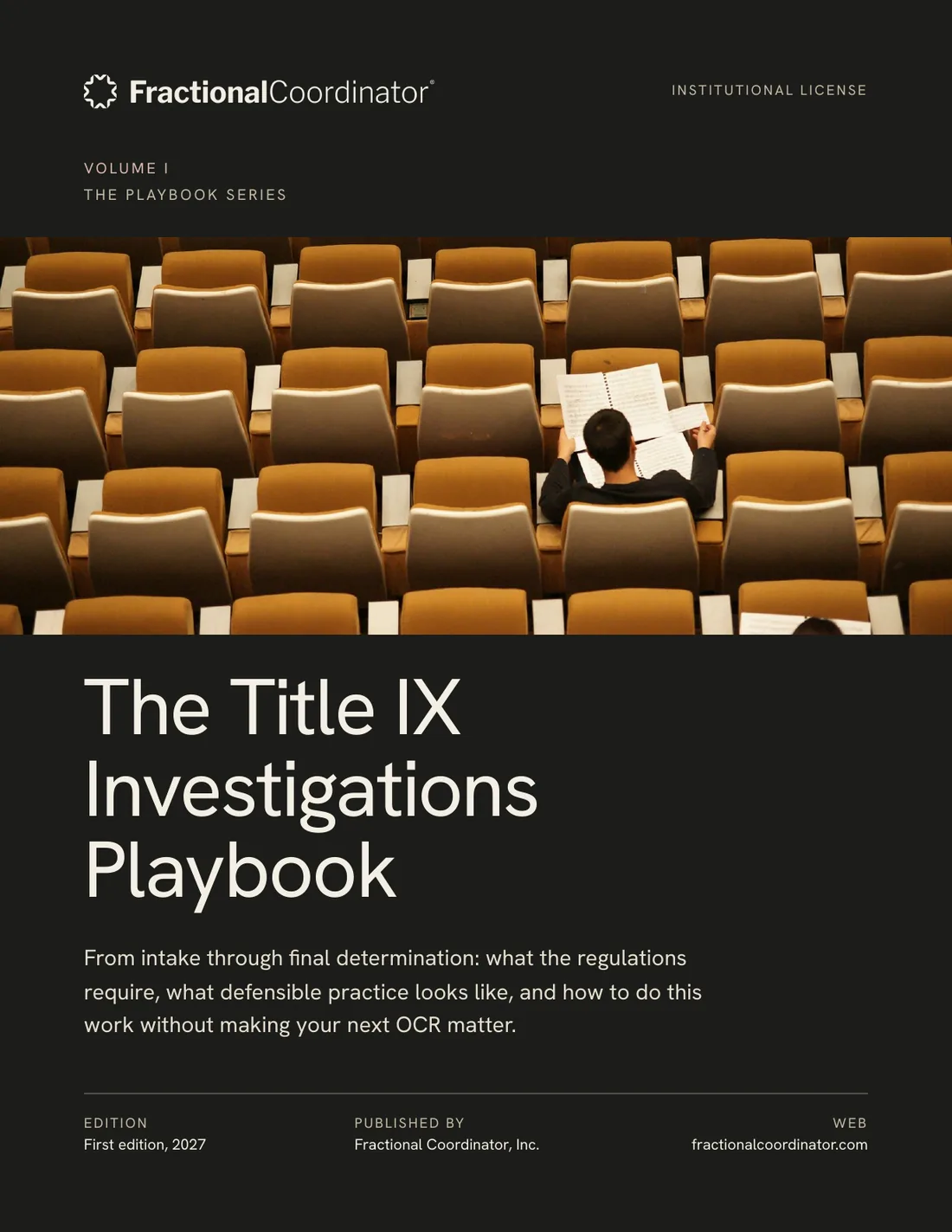
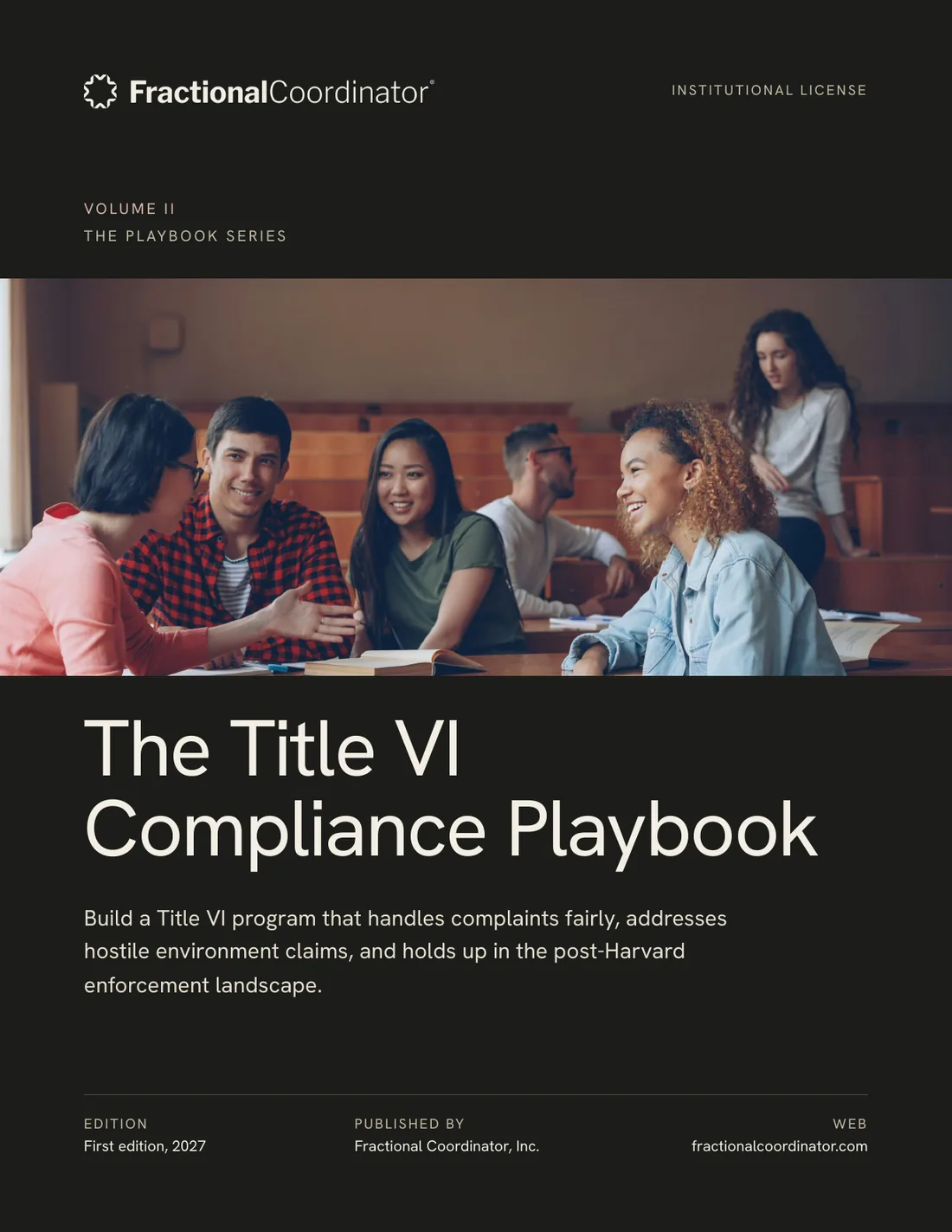
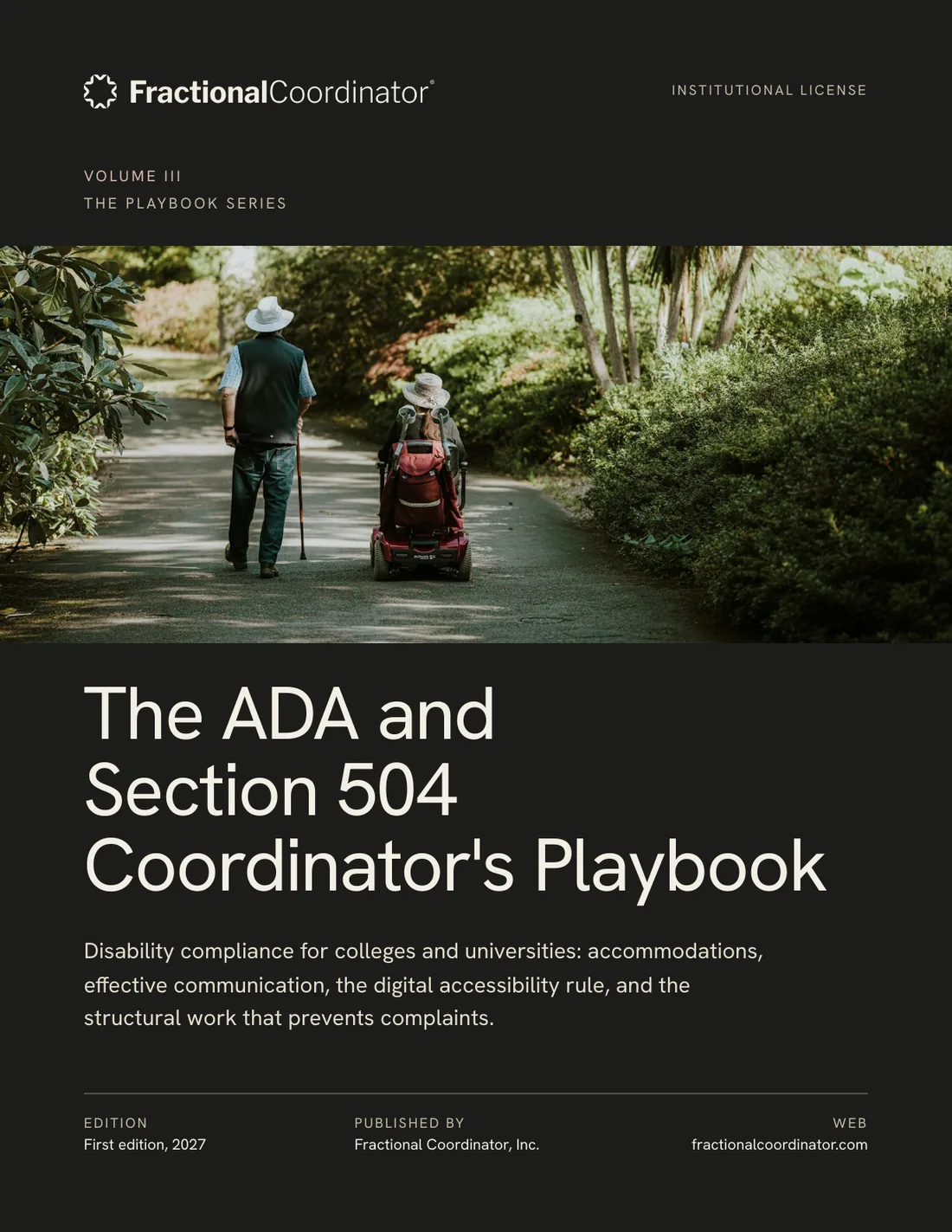
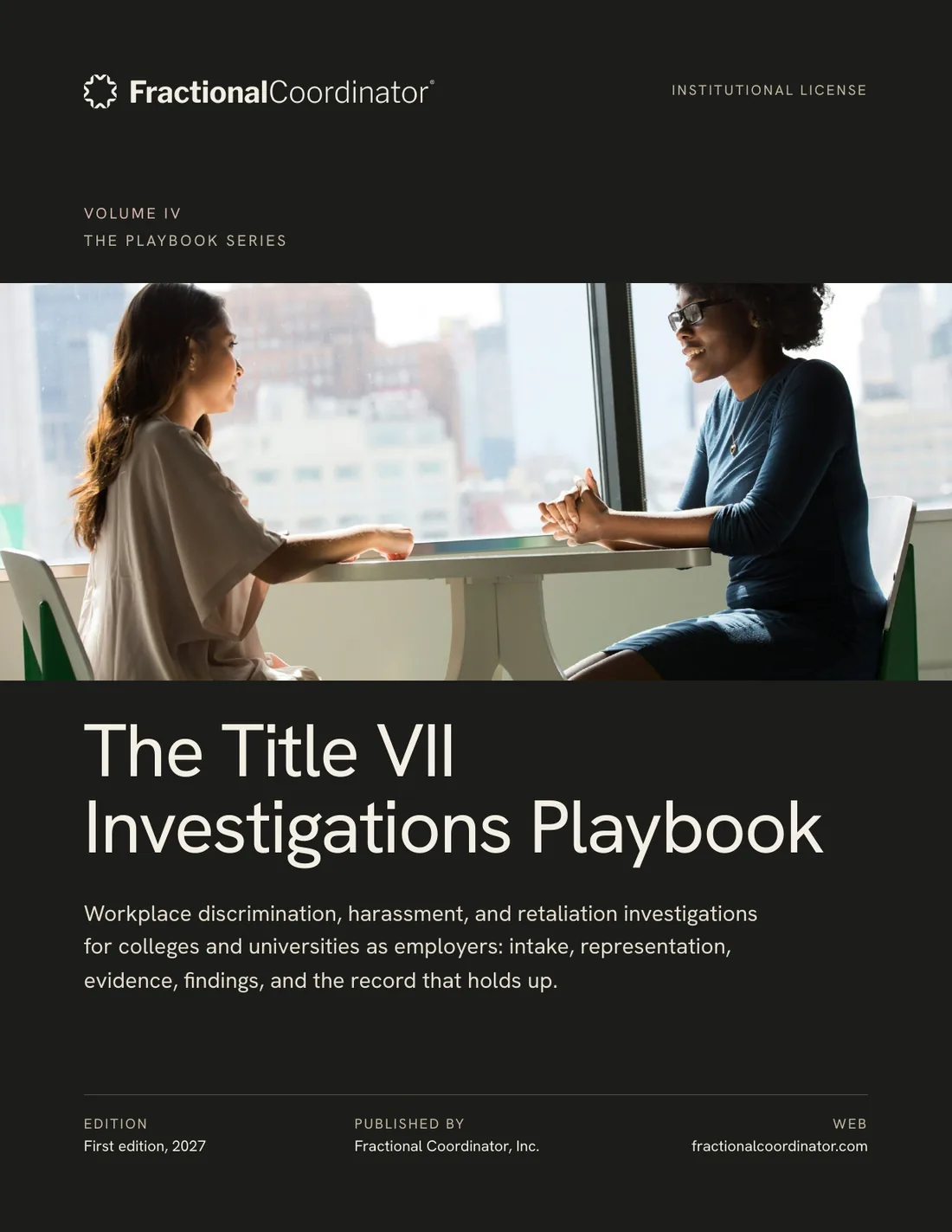
Practitioner playbooks for Title IX, Title VI, ADA, and Title VII, procedural fluency, not just policy text. Each playbook is a chapter-by-chapter guide your team will actually open.
Volume I · Second Edition · MMXXVI
From intake through final determination, what the regulations require, what defensible practice looks like, and how to do this work without making your next OCR matter.
Our flagship playbook. Used by Title IX teams.
Inside
Institutional license. Unlimited internal distribution. Free updates within the second edition cycle.
Volume II · First Edition · MMXXVI
How to build a Title VI program that handles complaints fairly, addresses hostile environment claims, and survives the post-Harvard enforcement landscape.
Updated for the Harvard lawsuit and the 2025–2026 OCR enforcement shift.
Inside
Institutional license. Unlimited internal distribution. Free updates within the first edition cycle.
Volume III · First Edition · MMXXVI
Disability compliance for institutions, accommodations, accessibility, the digital accessibility rule, and the structural work that prevents Section 504 complaints.
Includes the April 2026 DOJ Interim Final Rule and updated digital accessibility timelines.
Inside
Institutional license. Unlimited internal distribution. Free updates within the first edition cycle.
Volume IV · First Edition · MMXXVI
Workplace civil rights investigations for institutional employers, harassment, discrimination, retaliation, and the procedural rigor employment matters demand.
Concise reference for HR-side civil rights investigations.
Inside
Institutional license. Unlimited internal distribution. Free updates within the first edition cycle.
For membership pricing, please log in to the client portal.
Payment is handled end-to-end by Stripe. We never see your card details.
Non members receive their download by email upon purchase. Members also find their copy in the client portal.
Drawn from live investigations and OCR matters, procedural fluency, not just policy text.
Thank you
Your payment is confirmed. Download your playbook below, we’ve also emailed a receipt and a backup download link to the address you used at checkout.
Having trouble? Email hello@fractionalcoordinator.com with your receipt and we’ll sort it out.
Legal
How this website is built to be usable by everyone, the standard we hold it to, and how to reach us if something is in your way.
Effective · July 21, 2026
Fractional Coordinator is a civil rights compliance firm; accessibility is not an add-on to our work, it is our work. We want every visitor, including people who use assistive technology, to be able to read, navigate, and act on this site without barriers.
This website is designed to conform to the Web Content Accessibility Guidelines (WCAG) 2.1, Level AA. Automated testing across the site currently reports no WCAG 2.1 Level A or AA violations on desktop and mobile layouts. Automated testing cannot catch everything; manual review with screen readers, keyboard-only navigation, and magnification is part of our ongoing practice, and we treat conformance as a discipline rather than a milestone.
Some functions rely on third-party platforms: payments run through Stripe, session registration through Luma, live sessions through Google Meet, and some video content through YouTube. We select vendors with published accessibility programs, but we do not control their interfaces. If you encounter a barrier on a third-party surface, contact us and we will provide an accessible alternative, including completing any purchase or registration by phone or email.
Purchased playbooks and some resources are delivered as PDF files. On request, we will provide the substance of any document in an accessible alternative format.
If any part of this site is difficult to use, tell us. Describe the page, what you were trying to do, and the assistive technology you were using; we aim to respond within two business days and to fix verified barriers promptly.
hello@fractionalcoordinator.com · (503) 395-0687
Nothing on this page limits any rights you may have under applicable law, including the Americans with Disabilities Act and Section 504 of the Rehabilitation Act.
This statement was prepared on July 21, 2026, and is reviewed as the site changes.
Legal
How Fractional Coordinator collects, uses, retains, and discloses personal information, and the rights you have over your own data. Written in plain language; designed to be read by the people whose data we handle, not just by lawyers.
Effective · May 20, 2026
Fractional Coordinator is a civil rights compliance firm. We collect personal information from three groups: (1) institutional clients who engage us for investigations, fractional leadership, audits, and OCR matters; (2) individual practitioners who register for certifications, bootcamps, and workshops; and (3) visitors to this website. The information we hold, particularly investigation files and case records, is sensitive by nature, and we treat it accordingly.
From institutional clients. Names and contact information for engagement leads, scope and matter information necessary to perform the work, documents and data produced during investigations or audits, and billing information. We collect this because we need it to do the work you have engaged us to do.
From training registrants. Name, employer, role, email, phone, billing information, dietary or accessibility needs voluntarily provided for in-person events, and post-program feedback. We collect this to register you, deliver the program, issue your certificate of completion, and improve future cohorts.
From website visitors. Standard server logs (IP address, user agent, pages visited, timestamps) and any information voluntarily submitted through forms (newsletter signups, contact requests, demo requests). We collect this to operate and improve the site, respond to inquiries, and protect against abuse.
Investigation engagements routinely involve information that is sensitive even by privacy-policy standards: allegations of sexual misconduct, race- or national-origin-based discrimination, disability status, mental health information, medical records relevant to ADA matters, and the identities of witnesses and complainants who have requested confidentiality. We treat investigation files as legally privileged work product wherever the engagement letter establishes that privilege, and as confidential institutional records in all cases.
Investigation files are not used for any purpose other than the engagement. They are not used to train AI models, not anonymized and republished as case studies without the institution’s written consent, and not retained beyond the windows specified below.
We do not sell personal information. We do not share personal information with third parties for their own marketing. We do not use personal information from investigation files to train artificial intelligence systems.
We use a small number of vendors to operate our practice. Each one is bound by a written data processing agreement that requires them to handle our data only as we direct.
Investigation files are retained for the period specified in the engagement letter, typically seven years from the close of the matter unless the institution requests earlier return or destruction. After the retention window, files are securely destroyed and a destruction certificate is issued.
Training records (registration, attendance, certificate of completion, exam results) are retained for ten years to support credential-verification requests from former attendees. Marketing-list subscriptions are retained until you unsubscribe.
Website logs are retained for 90 days for security and abuse-prevention purposes, then deleted or aggregated.
Billing records are retained for seven years for tax and accounting purposes.
Depending on where you live, you have rights over the personal information we hold about you. We extend these rights to all individuals regardless of jurisdiction, because we think they are the right defaults.
To exercise any of these rights, write to us at privacy@fractionalcoordinator.com with enough information for us to identify you and verify the request. We respond within 30 days. If your request is unusually complex, we may extend the response window by another 30 days and tell you why.
Fractional Coordinator does not direct services to children under 13 and does not knowingly collect personal information from anyone under 13. PK–12 engagements are conducted with the institution as the data controller; FC processes student information only on the institution’s behalf and only as necessary to perform the engagement. If you believe a child under 13 has provided personal information directly to FC, contact us at privacy@fractionalcoordinator.com and we will delete it.
California residents have additional rights under the California Consumer Privacy Act (CCPA) as amended by the California Privacy Rights Act (CPRA), including the right to know what categories of personal information have been collected, the right to delete, the right to correct, the right to opt out of sale or sharing of personal information (we do not sell or share for cross-context behavioral advertising), and the right to limit use of sensitive personal information. We do not discriminate against California residents who exercise these rights.
Virginia, Colorado, Connecticut, and Utah residents have analogous rights under those states’ privacy laws. The substance of those rights is reflected in the “Your rights” section above; the procedural details follow each state’s framework.
EU and UK residents dealing with FC do so as a non-EU controller. To the extent we are subject to GDPR or UK GDPR, the lawful basis for processing personal information is generally legitimate interest (operating our practice, communicating with clients), contract (delivering services you have engaged us for), or consent (marketing communications, the quarterly digest). EU and UK residents have rights to access, rectification, erasure, restriction, portability, and objection. Fractional Coordinator does not currently process personal information of EU or UK residents in the regular course of business and has not designated an Article 27 GDPR representative. If the firm engages clients with substantial EU data-processing requirements, an EU representative will be designated and disclosed in this notice.
We maintain administrative, technical, and physical safeguards designed to protect personal information from unauthorized access, alteration, disclosure, or destruction. Specifics are described in our Security Notice. No system is perfectly secure; if we become aware of a breach affecting personal information, we will notify affected individuals and applicable regulators in accordance with applicable law.
We update this policy when our practices change or when applicable law requires it. Material changes will be flagged on this page and, where practicable, communicated to affected individuals by email. The “Effective” date at the top of this policy reflects the most recent change.
Effective: May 20, 2026. Next scheduled review: November 20, 2026. Prior versions are available on request from privacy@fractionalcoordinator.com.
For questions about this policy, written notices, or formal correspondence, use the channels below or write to us at our mailing address.
Fractional Coordinator, Inc.
830 NE Holladay St., Portland, OR 97232, United States
Phone: (503) 395-0687
Privacy questions: privacy@fractionalcoordinator.com
Resources
Practitioner playbooks, insights, and tools from the people who do civil rights compliance work every day. Some are here now; more are on the way.
For purchase · 4 titles
Practitioner playbooks for Title IX, Title VI, ADA, and Title VII, procedural fluency, not just policy text.
Explore playbooks →Articles
Practitioner writing on the operational realities of civil rights compliance, what the regulations require and what good practice adds.
Read insights →Members
Regulatory intelligence, decision frameworks, tools, and templates, the working reference for members.
Explore the Hub →Newsletter
Compliance updates, training dates, and audit-ready guidance for higher-ed, PK–12, and workplace teams, a few times a month.
Subscribe →Community · Biweekly
Biweekly calls where our community gathers to talk through emerging trends, new law, and the real-world scenarios coordinators are navigating.
Learn more →Podcast · Biweekly
Our biweekly podcast, breaking down high-level state and federal updates for civil rights compliance.
Listen →Community · Biweekly
A biweekly call where our community comes together, coordinators, investigators, and leaders, to talk through emerging trends, new law, and the real-world scenarios landing on your desk.
Coffee Talks is exactly what it sounds like: an open, off-the-record conversation among people who do this work. Every two weeks we gather by video to compare notes on what’s changing, a new OCR resolution, a shift in enforcement, a scenario nobody’s quite sure how to handle, and think it through together, out loud, with peers who get it.
A standing call every two weeks. Come to the ones you can, there’s no attendance requirement.
Indicate your interest below and we’ll email you an invitation, with the link and agenda, ahead of each call.
Candid conversation among practitioners. What’s said on the call stays on the call.
Real situations from real desks. Bring one to talk through, or just listen.
Tell us a little about you and we’ll email an invitation to the next call.
Thanks, you’re on the list.
We’ll email you an invitation to the next Coffee Talk, with the link and agenda.
Podcast · Biweekly
Our biweekly podcast, breaking down the high-level state and federal updates that matter for civil rights compliance, in plain language, for the people doing the work.
Every two weeks, Blueroom Podcast makes sense of the regulatory landscape: what changed, what it means, and what to actually do about it. No jargon for its own sake, just a clear read on the state and federal developments shaping Title IX, Title VI, ADA, and Title VII work. New episodes are published to our YouTube channel.
Albert Roberson, LL.M.
Host · Founder & CEO, Fractional Coordinator
Blueroom Podcast is hosted by Albert Roberson, founder and CEO of Fractional Coordinator. Drawing on well over 200 civil rights investigations and years serving as a Title IX, Title VI, and ADA / Section 504 officer, Albert walks through each edition’s state and federal developments the same way he’d talk them through with a coordinator across the desk, clearly, candidly, and with an eye on what it means for your program on Monday morning.
From time to time, Albert is joined by a guest, a fellow practitioner, an institutional leader, or a subject-matter expert, to dig into a specific issue or share a view from another corner of the field. Guests appear by invitation. If there’s a voice you’d like to hear on the show, let us know.
Newsletter
Compliance updates, training dates, and audit-ready guidance for higher-ed, PK–12, and workplace teams, a few times a month, straight to your inbox.
The Fractional Digest is our running read on what’s changing in civil rights compliance and what it means for your program. Short, practical, and written by practitioners, no filler.
What changed at the state and federal level, and whether it affects you.
Upcoming certifications, workshops, retreats, and Coffee Talks.
Audit-ready checklists and templates you can put to work this week.
A few times a month. Unsubscribe anytime.
You’re on the list.
Watch your inbox for the next issue of the Fractional Digest.
Legal
The agreement governing your use of fractionalcoordinator.com, the programs you register for, and the services you engage us to provide. We have tried to write these the way we wish vendor terms were written for us, specific, fair, and free of language designed to surprise you later.
Effective · May 20, 2026
By visiting this site, registering for a Fractional Coordinator program, or engaging us for services, you accept these terms. Engagement letters and program-specific terms (described below) layer on top of this base agreement and govern in case of conflict. If you are agreeing on behalf of an institution, you represent that you have the authority to bind that institution.
“Fractional Coordinator,” “FC,” “we,” and “our” refer to Fractional Coordinator, Inc., a Delaware corporation with its principal place of business at 830 NE Holladay St., Portland, OR 97232, United States. “You” refers to the individual or institution accepting these terms, whether by browsing this site, registering for a program, or signing an engagement letter.
You may browse, read, and reference content on fractionalcoordinator.com for any lawful purpose. Subject to your acceptance of these terms, we grant you a limited, revocable, non-exclusive, non-transferable license to view and use the site for personal informational purposes or for evaluating whether to engage us.
You agree not to:
We reserve the right to suspend or terminate access to anyone who materially violates these terms.
Our content. Site content, written copy, design, code, graphics, regulatory analysis, training materials previewed publicly, and the FC name and logo, is owned by Fractional Coordinator or licensed to us. You may not reproduce, redistribute, or create derivative works from our content without written permission, except for fair-use quotations with attribution.
Your content. If you submit feedback, questions, or other voluntary communications through the site, you grant us a non-exclusive, royalty-free license to use that content to improve the site and our practice. We will not publish your name or specific quote without your written permission. We do not claim ownership of your content.
Registration for a Fractional Coordinator program (certification, bootcamp, workshop, retreat) creates a contractual relationship between you (or your institution, if registering on its behalf) and FC. The terms of that relationship are governed by these Terms of Use, the program-specific page on this site, the registration confirmation, and any institutional master service agreement that supersedes them.
Registration and delivery of programs may be handled through third-party platforms, including Luma for booking and Zoom or Google Meet for live sessions. Your use of those platforms is subject to their own terms, and Fractional Coordinator is not responsible for their availability or performance.
Certification claims. What our certificates do and do not confirm is described in detail in our Certification Notice. In summary: certificates confirm completion of the program, not external accreditation. SHRM Recertification Provider status and state bar CLE accreditation are pursued and may not be in place at the time you register; we provide attendance documentation for self-submission.
Cancellation and refunds. Cohort programs may be canceled by the registrant up to 14 days before the cohort start date for a full refund, or up to 7 days before for a 50% refund. Cancellations within 7 days of the cohort start are non-refundable but may be applied as a credit toward a future cohort within the same calendar year. Workshops may be canceled up to 48 hours before the start time for a full refund. If FC cancels a cohort or workshop for any reason, all registrants receive a full refund.
Substitutions. Registrants may transfer their seat to another individual at the same institution at any time before the program begins, at no charge. Email training@fractionalcoordinator.com with the substitute’s information.
Materials. Program guidebooks, slide decks, templates, and recordings provided as part of a program are licensed to the individual registrant for personal professional use. They may not be redistributed, posted publicly, or used to create competing training products. Institutional licenses for broader internal use are available on request.
Investigations, fractional leadership, audits, OCR matter representation, and similar engagements are governed by a written engagement letter signed by both parties. Where the engagement letter conflicts with these terms, the engagement letter governs.
Engagement letters specify scope, deliverables, fees, retention, confidentiality, privilege, conflict-of-interest representations, and termination rights. Most FC engagement letters include a 30-day mutual termination provision and a fee cap or fixed-fee structure. We do not bill on a contingency basis.
Programs are billed at registration through Stripe, our payment processor. Group rates apply at quantities of 5 or more registrants from the same institution; the discount is applied automatically at checkout.
Engagements are billed monthly in arrears against the engagement letter. Invoices are due net 30. Past-due invoices accrue interest at 9% per annum (0.75% per month) or the maximum rate permitted by law, whichever is lower.
Expenses are billed at cost without markup, capped at 5% of the engagement value unless otherwise specified in the engagement letter. Travel expenses for on-site work are billed at cost.
If you dispute a charge, write to billing@fractionalcoordinator.com within 30 days of the invoice date with the specifics of the dispute. We will respond within 10 business days. Payments are not withheld during disputed-charge resolution; we will issue a credit if the dispute is resolved in your favor.
Information shared with us in the course of an engagement is confidential. We do not disclose client identities, matter specifics, or any information that could identify a complainant, respondent, or witness in an investigation, except: (a) with the institution’s written consent; (b) as required by legal process; or (c) as necessary to defend FC in a legal matter.
The same confidentiality protections extend to information shared by training registrants in case-discussion settings; we expect the same of attendees with respect to one another.
Not legal advice. Fractional Coordinator is a civil rights compliance firm, not a law firm. Our work is informed by law and frequently coordinated with attorneys, but it is not a substitute for legal advice. Engagement letters specify when, if ever, our work product is intended to be subject to legal privilege; in most cases, we recommend institutions engage us through their general counsel to preserve privilege.
Outcomes. Compliance work is inherently uncertain. We do not guarantee a particular outcome in an investigation, an OCR matter, an audit, or a credentialing application. We commit to the quality of our process, not to a specific result.
Site content. Information on this site is provided for general informational purposes. Regulatory frameworks change frequently; while we update content regularly, no guarantee is made that all content reflects the most current law. Verify with counsel or your regulator before relying on site content for an institutional decision.
Third-party links. The site may link to external resources. We are not responsible for content on third-party sites and do not endorse them by linking.
To the maximum extent permitted by law, Fractional Coordinator’s aggregate liability arising out of or relating to these terms, your use of the site, your participation in a program, or any engagement is limited to the fees you have paid to FC in the twelve months preceding the event giving rise to the claim. Neither party is liable to the other for indirect, incidental, consequential, special, or punitive damages, including lost profits or business interruption, regardless of legal theory.
The limitations in this section do not apply to (a) FC’s indemnification obligations under an engagement letter; (b) liability arising from FC’s gross negligence or willful misconduct; or (c) any liability that cannot be limited under applicable law.
You agree to indemnify and hold harmless Fractional Coordinator and its officers, directors, employees, contractors, and agents (collectively, the “FC Parties”) from claims arising out of (a) your violation of these terms, (b) your violation of any third-party right through your use of the site or programs, or (c) your provision to FC of information that infringes a third party’s rights or violates applicable law.
FC indemnifies institutional clients only as provided in their engagement letter, not under these Terms of Use.
We may suspend or terminate your access to the site at any time for material breach of these terms or for conduct we reasonably determine harms FC, our clients, or other users.
You may terminate your relationship with FC by closing your account (if applicable), unsubscribing from communications, and requesting deletion of your data as described in our Privacy Policy. Engagement-letter terminations are governed by the engagement letter.
These terms are governed by the laws of the State of Oregon, without regard to conflict-of-laws principles. Any dispute arising out of or relating to these terms or your relationship with FC will be brought exclusively in the state or federal courts located in Multnomah County, Oregon, and both parties consent to personal jurisdiction in those courts.
Before initiating formal legal proceedings, both parties will attempt in good faith to resolve disputes informally for at least 30 days, beginning when the disputing party sends a written notice describing the dispute to the other party.
We update these terms when our practices change or when law requires it. Material changes will be flagged at the top of this page for 30 days and, where practicable, communicated to active clients and registrants by email. Continued use of the site or participation in a program after the effective date of changed terms constitutes acceptance of the changes.
Effective: May 20, 2026. Next scheduled review: November 20, 2026. Prior versions are available on request from terms@fractionalcoordinator.com.
For questions about these terms, written notices, or formal correspondence, use the channels below or write to us at our mailing address.
Fractional Coordinator, Inc.
830 NE Holladay St., Portland, OR 97232, United States
Phone: (503) 395-0687
Legal & contracts: terms@fractionalcoordinator.com
Legal
What we use cookies for, what we don’t, and how to control them. Short, because we use few cookies and we don’t track you across the web.
Effective · May 20, 2026
Cookies are small text files that websites store on your device. They serve various purposes, some make a site work at all, some remember your preferences, some report aggregate usage to the site owner, and some track you across multiple sites for advertising. Fractional Coordinator uses only the first three kinds. We do not use advertising cookies and we do not allow third parties to use this site for cross-context behavioral advertising.
Browsers let you accept, reject, or delete cookies. Each browser has its own controls, generally found under Settings > Privacy. Useful documentation:
If you disable strictly necessary cookies, parts of the site, particularly the checkout flow, will not work. We do not block your access to other content for declining non-essential cookies.
Modern browsers and privacy extensions can send signals indicating you do not want to be tracked. Because we do not track visitors across sites for advertising or analytics purposes, these signals do not change our behavior, we already operate as if you had sent them. If we add analytics in the future, we will honor Global Privacy Control (GPC) signals where applicable.
If we add or remove cookies, we will update this page and the “Effective” date above. Material changes (for instance, adding any cookie that processes personal information for a new purpose) will be flagged at the top of this page for 30 days.
Effective: May 20, 2026. Next scheduled review: November 20, 2026.
For questions about this policy, written notices, or formal correspondence, use the channels below or write to us at our mailing address.
Fractional Coordinator, Inc.
830 NE Holladay St., Portland, OR 97232, United States
Phone: (503) 395-0687
Cookie & privacy questions: cookies@fractionalcoordinator.com
Help
Straight answers on engagements, payments, training, OnePointe, confidentiality, and how we work. Can't find what you need? Get in touch.
It depends on scope and conflicts, but we're built for speed, for most matters we can be in intake within days of a signed engagement letter. If you're facing a deadline, tell us up front and we'll move accordingly.
Our practice is centered on U.S. federal civil rights frameworks, Title IX, Title VI, Title VII, ADA/504, and Clery, so our engagements are with U.S. institutions. We don't currently process EU or UK personal data in the regular course of business. If you have a cross-border question, get in touch.
Fractional and interim leadership is scoped per institution, coverage during a leave, capacity during a surge, or a standing partnership. Most engagements use a fee cap or fixed-fee structure; we don't bill on contingency. Reach out for an estimate.
Yes. We support institutions through open OCR matters, including resolution-agreement negotiation and the operational work an active matter requires. Where privilege matters, we often recommend engaging us through your general counsel.
Yes. We'll give you a scope and an estimate before any engagement letter is signed, and there's no cost to have that conversation.
We reserve limited capacity for pro-bono and advisory work. Reach out and tell us about your situation, we can't promise availability, but we'll consider it.
We provide interim, fractional, and standing coordination, including long-term partnerships for institutions that can't justify a full-time role. A fractional partnership can run indefinitely; most engagement letters include a 30-day mutual termination provision so neither side is locked in.
Tell us immediately. We're set up to move quickly on deadline-driven matters and will prioritize accordingly once an engagement letter is in place.
Yes. We regularly take over matters in progress, reviewing the file, preserving the record, and carrying the investigation through to a defensible written report.
No blanket minimum. Most engagement letters include a 30-day mutual termination provision.
Program registrations are billed through Stripe, our payment processor (major cards, plus wallet options where available). Institutional engagements are invoiced.
For cohort programs: a full refund up to 14 days before the start date, or 50% up to 7 days before. Within 7 days it's non-refundable but can be applied as a credit toward a future cohort in the same calendar year. Workshops are fully refundable up to 48 hours before the start. If we cancel, all registrants receive a full refund.
Yes. Engagements are invoiced monthly in arrears, net 30, and we can provide the documentation your purchasing or accounting office needs.
Yes. Payments run through Stripe; we never see or store full card numbers.
Engagements are billed monthly against the engagement letter. For program tuition, reach out, we can often accommodate institutional purchasing processes.
Yes, for institutional engagements and group registrations. Email billing@fractionalcoordinator.com to set it up.
Engagement invoices are due net 30. Past-due invoices accrue interest at 9% per year (0.75% per month) or the maximum rate permitted by law, whichever is lower.
Many employers reimburse professional development. We provide registration confirmations and attendance documentation you can submit to your employer's PD or tuition-reimbursement program.
Our certificates confirm completion of the program, not external accreditation. SHRM Recertification Provider status and state bar CLE accreditation are pursued and may not be in place when you register; we provide attendance documentation for self-submission. Our Certification Notice covers this in detail.
Cohort and retreat programs run on set dates, and any completion requirements, an assessment or a follow-up reflection, for example, have their own windows described on each program page.
You can transfer your seat to another person at the same institution at no charge before the program begins, email training@fractionalcoordinator.com. Rescheduling follows the cancellation and credit policy in our Terms of Use.
Yes, custom institutional training tailored to your frameworks and context. Reach out to scope it.
Yes. A group rate applies automatically at checkout for 5 or more registrants from the same institution.
We pursue SHRM and state bar CLE recognition and provide hour-by-hour attendance documentation for self-submission. Availability varies by program and may not be in place at registration.
Certifications include an assessment and a credential; bootcamps are intensive multi-day cohorts; workshops are focused, shorter sessions on a specific framework or skill. Our retreats are the most immersive multi-day format.
Yes, contact training@fractionalcoordinator.com to arrange a retake.
We consider a limited number of scholarship and sliding-scale requests, especially from under-resourced institutions. Get in touch and tell us about your situation.
We recommend annual refreshers to keep pace with regulatory change. We retain your training records for ten years to support credential-verification requests.
The Knowledge Hub is our members' working library, regulatory intelligence, decision-making frameworks, tools and templates, and case studies. Membership tiers and details are listed on the Knowledge Hub Membership.
Yes. Institutional and team memberships are available; contact us for team pricing.
Memberships renew from your account, and you'll get a reminder before the renewal date.
Use the password-reset link on the sign-in page. If you're still stuck, email us and we'll help you regain access.
Reach out and we'll walk you through what's included before you commit.
Institutional members get scheduled time with our team for questions on live matters, program design, and regulatory developments.
Membership and professional-development fees are often deductible as a business expense, check with your tax advisor.
Individual memberships stay with you; institutional seats stay with the institution. Contact us to update your record.
OnePointe is our AI-powered case-management platform for civil rights compliance, built for the intake-to-resolution workflow at universities and PK-12 districts. It's a separate product; learn more at onepointe.ai ↗.
No. OnePointe is our case-management software product; the FC Client Portal is where engagement clients access their own materials. They're separate systems.
Request a demo at onepointe.ai ↗, or get in touch and we'll connect you.
Pricing is available on the OnePointe site and scales with your institution. See onepointe.ai ↗.
OnePointe's application database and authentication run on Supabase, in U.S. data centers. Supabase is SOC 2 Type II compliant.
Integration options are covered on onepointe.ai ↗, reach out to discuss the systems you use.
Yes. OnePointe is available as standalone software; you don't have to engage FC's services to use it.
Yes. Information shared in an engagement is confidential. We don't disclose client identities, matter specifics, or anything that could identify a complainant, respondent, or witness, except with your written consent, as required by legal process, or as necessary to defend FC. The same expectation applies to case discussions in training.
Investigation files are retained per your engagement letter, typically seven years from the close of the matter, unless you request earlier return or destruction. After the retention window, files are securely destroyed and a destruction certificate is issued.
Investigation files are confidential institutional records, and privileged work product where the engagement establishes privilege. We hold them on your behalf under the engagement letter.
We respond to legal process and support institutions through OCR matters. Disclosure otherwise requires your written consent.
Yes. NDAs are commonly part of engagement onboarding and are executed electronically via DocuSign.
Access is restricted to authorized FC personnel working your matter, and it's audited. Active investigation files are held on FC-managed private infrastructure in U.S. data centers.
Discoverability depends on privilege and the facts. Engagement letters specify whether work product is intended to be privileged, and engaging us through your general counsel helps preserve privilege. This isn't legal advice, consult your counsel.
Not without your written permission. Investigation files are never anonymized and republished as case studies without the institution's written consent.
On U.S.-based infrastructure. Application data runs on Supabase (U.S.); active investigation files and privileged work product are held on FC-managed private servers in U.S. data centers. Our Privacy Policy lists every subprocessor.
In PK-12 and higher-ed engagements, the institution is the data controller and FC processes student information only on its behalf, as needed to perform the engagement, consistent with FERPA's school-official framework. Specifics are set in the engagement letter.
We don't currently process EU or UK personal data in the regular course of business and haven't designated an Article 27 representative. If an engagement requires substantial EU processing, we'll designate one and disclose it. See our Privacy Policy.
No. We do not use personal information from investigation files to train artificial-intelligence systems.
If we become aware of a breach affecting personal information, we notify affected individuals and applicable regulators in accordance with applicable law.
No. We don't sell personal information, and we don't share it with third parties for their own marketing.
Yes, email privacy@fractionalcoordinator.com. We respond within 30 days, with a possible 30-day extension for complex requests. Records in active engagement files can't be unilaterally deleted without the engaging institution's consent.
Yes, community colleges, four-year institutions, and university systems.
Yes, and we often do. Where privilege matters, we frequently work through or alongside your counsel.
Yes, including the operational realities specific to intercollegiate athletics.
We assess jurisdiction up front and run the matter under the right framework or frameworks, one of the most common and most-missed issues in the field. Our playbooks address these intersections directly.
Yes, proactive compliance review, documentation, and audit readiness are core to our work.
Yes. We coordinate our process with applicable collective-bargaining and employment obligations.
Yes, public districts, charter schools, and private schools.
We build mandatory-reporting obligations into intake and process design, coordinated with your counsel and state requirements.
Yes, governance-level training for boards is available.
Yes. Our ADA/504 work covers the accommodation and grievance processes that intersect with IEPs and 504 plans.
Yes, we support state-level investigations as well as federal OCR matters.
If you want a credential that proves competence, not just attendance, and a working reference for the role, yes. Our certifications include an assessment and are built for practicing coordinators.
Start with a foundational certification or a framework workshop, plus the relevant playbook. Reach out and we'll point you to the right entry point.
Often, yes, we provide the documentation to submit. See the training FAQs above on CE credit.
The Fellows program is designed for early-career practitioners. Reach out and we'll help you figure out whether it's the right fit.
Yes, our community, including Coffee Talks, connects practitioners for off-the-record peer exchange.
We welcome practitioner contributions to Insights and guests on the Blueroom Podcast. Get in touch.
No. Fractional Coordinator is a civil rights compliance firm, not a law firm. Our work is informed by law and often coordinated with attorneys, but it isn't a substitute for legal advice.
We're not litigation counsel. We conduct neutral investigations and provide compliance support; we don't advocate for a party in litigation, and we don't bill on contingency.
We don't give legal advice, guarantee outcomes, take contingency work, or serve as a party's litigator. We commit to the quality of our process, not to a specific result.
We're practitioners who've done this work inside institutions. We pair investigations with fractional leadership, certified training, and software (OnePointe), with a consistent standard: outcomes that hold up under audit.
Reach out at hello@fractionalcoordinator.com or through our contact page, we're happy to help.
Where an engagement requires it, yes. Several of our subprocessors, including Google Workspace and Zoom, are HIPAA-eligible under separate BAAs. Talk to us about your requirements.
Members
The working reference for civil rights compliance practitioners, regulatory intelligence, decision frameworks, tools, and templates, kept current so you don’t have to.
Plain-language briefings on state and federal changes as they land.
Structured guidance for the calls coordinators actually have to make.
Options, scripts, and documentation for supportive measures.
Model policies and the architecture of a defensible program.
Anonymized, instructive breakdowns of how matters unfold.
The source documents, rules, resolutions, and guidance, in one place.
Intake forms, report templates, and checklists you can adapt.
Quarterly reads for leadership on where the landscape is heading.
Access to all eight collections comes with every membership below.
Three tiers, from individual practitioners to active engagement clients.
For coordinators, investigators, ADA officers, and compliance staff working inside a single institution.
For compliance teams, Title IX offices, and HR departments. Starts at 5 seats and scales to enterprise.
Bundled with active investigations, fractional leadership, or compliance engagements.
You have been securely signed out of the client portal.
Sign back inNeed help? Reach your engagement lead, or write to hello@fractionalcoordinator.com
Fellowship
A selective fellowship for the next generation of civil rights compliance leaders. Each year we select two fellows to gain real-world experience alongside our practitioners and to complete an original research project that advances the field.
The Fellows Program is how we invest in the people who will lead this field. It is built in the tradition of immersive leadership and research fellowships: fellows do the work, they do not only study it, and they leave having produced something that matters.
Two commitments define the experience. The first is real-world practice. Fellows work beside our team on live matters, from intake through resolution, and build the judgment the work demands. The second is research. Each fellow conceives and completes an original research project on a question facing the field, finished ahead of the program's conclusion and shared with practitioners.
The fellowship is deliberately small. We select two fellows each year. Keeping the cohort small lets us invest deeply in each fellow, pair real mentorship with real responsibility, and hold the standard that makes the credential mean something.
Fellows are embedded with our practitioners on live civil rights matters across Title IX, Title VI, Title VII, ADA and Section 504, and the Clery Act. The exposure is structured and supervised. You sit in on intake, help build the record, watch decisions get made, and learn why. This is the part of the work you cannot get from a webinar.
Every fellow conceives and completes an original research project on a question the field needs answered. You scope it early with an FC mentor, develop it across the fellowship, and complete it ahead of the program's conclusion. Finished projects are published under the Fractional Coordinator banner and presented to our practitioner network.
Supervised practice on live matters, from intake through resolution.
A substantial, publishable body of work with your name on it.
Paired with a practitioner who has done this work inside institutions.
Our certification and framework workshops, included at no cost.
Your research published and presented to practitioners in the field.
A small peer cohort and lasting access to our practitioner community.
A completion credential and a strong reference for your next step.
Coffee Talks, the retreats, and the people who take this work seriously.
The research project is the heart of the fellowship. It is what separates this program from a training track. Each fellow chooses a question that matters: something the field is getting wrong, an area with no good guidance, a practice worth testing, and does the work to answer it.
You are not on your own. An FC mentor helps you scope the project in the first weeks, meets with you throughout, and holds you to a standard the field will respect. The project is finished ahead of the fellowship's conclusion so that it can be reviewed, published, and presented while you are still with us.
Recent and example research areas include:
Areas fellows might explore include supportive-measure design, the defensibility of informal resolution, accessibility grievance processes in PK-12, and Clery classification. The question can be your own.
Orientation, training, and a first pairing with your mentor. You scope your research question early.
You join live matters alongside our team and begin building a record of real work.
Your project takes shape. You research, draft, and refine with your mentor throughout.
You finish your project ahead of the program's end, publish it, and present it to the network.
The fellowship is built for people in the early years of civil rights work, and for those moving into the field from adjacent roles: human resources, student affairs, legal, or PK-12 administration. You do not need years of experience. You need to take the work seriously, to write clearly, and to be genuinely curious about a question the field has not yet answered.
Tell us about yourself and the question you would want to spend a year on.
A conversation with our team about fit, your goals, and your proposed research.
Two fellows are selected each year. We invest fully in both.
When a matter reaches litigation or a contested hearing, the question becomes what a careful institution should have done. We help courts, counsel, and panels answer it.
Our practitioners serve as expert witnesses in state and federal cases involving Title IX, Title VI, Title VII, ADA and Section 504, and the Clery Act. We are retained by plaintiffs and by defendants, and the opinion is the same either way: an independent reading of the record against the standard of care, from people who have actually run these processes inside institutions.
Every engagement begins with a conflicts check and ends with work built to withstand scrutiny: written opinions grounded in the regulations, the guidance, and the practice literature, delivered by witnesses who can explain them plainly under cross-examination.
Non-testifying support for counsel: record and file review, case theory on the compliance questions, and preparation for the examination of opposing experts.
Written standard-of-care analysis grounded in the regulations, the guidance, and the practice literature: notice, process, timeliness, sanctions, and documentation. Rebuttal reports included.
Testimony in state and federal court, for plaintiffs and for defendants, with foundations built to survive challenge.
Party-retained expert testimony inside institutional proceedings, where the regulations permit it, briefed on the record and delivered with respect for the forum.
A focused intake call, a conflict screen across our client base, and a written engagement with the questions defined and the retainer set.
A full reading of the file against the standard of care: the policies, the timeline, the communications, and the decisions.
A written opinion built for disclosure, with the reasoning shown and the sources cited.
Deposition, trial, or hearing, delivered plainly and defended under cross-examination.
Pricing for expert engagements.
Non-testifying. Record review, case theory, and counsel support. No disclosure obligations attach.
Reports and written opinions at $475. Deposition and trial testimony at $600, with a half-day minimum for testimony. A $5,000 retainer opens the engagement and is applied against fees.
Party-retained testimony in institutional proceedings, plus preparation at $425 per hour. Available on compressed timelines.
Every engagement opens with a conflicts check. Travel is billed at cost, retainers are applied against fees, and unused balances are returned.
Legal
What a Fractional Coordinator certificate does and does not confirm, written plainly, so no one relying on it is surprised later.
Effective · May 20, 2026
A Fractional Coordinator certificate confirms that the named individual completed the program described on it, that they attended the required sessions and met the program’s completion requirements, which may include an assessment. That is what the certificate attests to.
Our certificates are not a license, and they are not an accreditation by a government body or an independent accreditor. Completing an FC program does not confer legal authority and does not make you a licensed professional. A certificate should not be represented as an external accreditation.
We pursue SHRM Recertification Provider status and state bar CLE accreditation for eligible programs. That status may not be in place at the time you register. For every program, we provide attendance documentation and an hour-by-hour agenda so you can self-submit to SHRM, HRCI, or your state bar. We do not guarantee that any particular body will award credit.
You may state that you completed the specific FC program named on your certificate. You may not overstate, alter, or imply an accreditation, affiliation, or authority the certificate does not confer. Misrepresentation may result in revocation of the credential.
Institutions can verify a certificate by writing to certifications@fractionalcoordinator.com with the holder’s name and program. We retain training records for ten years to support verification requests.
We update this notice when our programs or accreditation status change. The “Effective” date above reflects the most recent change.
For questions about a certificate or our programs, use the channels below.
Fractional Coordinator, Inc.
830 NE Holladay St., Portland, OR 97232, United States
Programs: training@fractionalcoordinator.com
Verification: certifications@fractionalcoordinator.com
Legal
How we protect the information you trust us with, particularly the investigation files, which are among the most sensitive records there are.
Effective · May 20, 2026
We maintain administrative, technical, and physical safeguards designed to protect information from unauthorized access, alteration, disclosure, or destruction. Our controls are proportional to the sensitivity of the data, and the data we handle in investigations is as sensitive as it gets.
Access to client and engagement data is restricted to authorized FC personnel with a need to know, granted on a least-privilege basis and reviewed regularly. Access to active investigation files is logged and audited.
Data is encrypted in transit (TLS) and at rest. Credentials are stored using industry-standard hashing; we never store full payment card numbers, which are handled by Stripe.
Application data and authentication run on Supabase, in U.S. data centers; Supabase is SOC 2 Type II compliant. Active investigation files and privileged work product are held separately on FC-managed private infrastructure in U.S. data centers, storage we control directly, because the sensitivity of that material requires it.
We use a small, vetted set of subprocessors, each bound by a written data processing agreement and each SOC 2 Type II audited where applicable. The current list, with the data each one handles, is in our Privacy Policy.
Investigation files are segregated from general application data. They are never used to train AI systems, and they are never anonymized and republished without the engaging institution’s written consent.
No system is perfectly secure. If we become aware of a breach affecting personal information, we notify affected individuals and applicable regulators in accordance with applicable law, without undue delay.
If you believe you’ve found a security vulnerability affecting Fractional Coordinator, please email security@fractionalcoordinator.com. We appreciate responsible disclosure and will acknowledge your report.
We update this notice as our practices evolve. The “Effective” date above reflects the most recent change.
Membership
The standards we hold ourselves to as a membership organization, and the conduct we ask of members in return. Brief, because most of this is common professional practice.
Effective · May 20, 2026
Membership in the Knowledge Hub, the Practitioner Roundtables, and Fractional Coordinator certification cohorts is a shared professional space. The standards below apply to all members regardless of tier or program.
Client Portal
Everything for your engagements with us in one place.
Engagement status
Active
All workstreams current
Open action items
0
Waiting on your team
Next invoice
–
Documents are shared here by your engagement lead, and originals are also delivered by email.
Files here are shared by your engagement team for each matter. Access is limited to portal users your administrator has granted.
Items your team has asked you to complete. Checking an item notifies your engagement lead.
Invoices are issued by email through Stripe. This view mirrors their status for reference.
Collections are curated by Fractional Coordinator. New material lands here as it publishes.
Registrations are confirmed by email. Member discounts are applied at invoicing.
Profile details are managed by your engagement lead. To change your name, email, or institution, contact your lead.
Training request
Tell us what you’re looking for and we’ll get back to you with options, dates, and pricing. Takes about a minute.
1
2
3
4
Optional, helps us tailor the conversation.
5
6
7
A rough number is fine.
8
9
A member of our team will engage with you shortly. We endeavor to respond to all training requests within 24 hours.
Fellows application
A short application: who you are, how you practice, and two documents. Takes about five minutes.
1
2
3
4
5
6
7
8
No names, no identifying details.
9
PDF preferred, up to 5 MB.
10
A findings memo, investigation report, or policy you authored. Redact all names and identifying details before uploading.
11
We review applications on a rolling basis and respond to every applicant.
The Fractional Digest · June 2026
Campuses empty out. The compliance calendar doesn’t. Why the quiet months are the ones that decide how your fall goes.
Every summer the buildings empty and the pace drops, and every fall, the programs that struggle are the ones that treated those months as downtime. Summer is when the year’s open matters get closed, when policies get revised against whatever changed over the last twelve months, and when you have room to fix the things the fall won’t give you time to touch. Spend it well and September feels manageable. Spend it as a break and you inherit last year’s problems on day one.
We don’t predict which matter gets reviewed, that’s the whole point. But the questions that come up most, across frameworks, are boringly consistent: Were timelines met, and documented? Were supportive measures offered, and is there a record? Was jurisdiction assessed before the process started, or assumed? Does the file read the same to the parties as it will to a reviewer months later? None of that is exotic. All of it is easier to get right before the volume returns.
The institutions that hold up under scrutiny are the ones that treated every file as if it would be the one reviewed, not because they expected trouble, but because a fair process and a provable process are the same thing. Summer is when you build that, quietly, before anyone’s watching.
The Fractional Digest is practical guidance, not legal advice. Regulatory frameworks change frequently, verify the current state of the law with your counsel or regulator before acting.
The Fractional Digest · May 2026
The ADA Title II web rule’s first compliance deadline has arrived. Here’s what it requires, who it covers, and where institutions get caught.
In April 2024, the U.S. Department of Justice finalized a rule under Title II of the Americans with Disabilities Act setting, for the first time, a specific technical standard for digital accessibility: WCAG 2.1 Level AA. It applies to state and local government entities, a category that includes public colleges and universities, community colleges, and PK-12 school districts. If your institution is a public entity, this rule reaches your websites, your web content, and your mobile apps.
Compliance is phased by size. Public entities serving populations of 50,000 or more were required to conform by April 24, 2026. Smaller public entities, and special district governments, have until April 26, 2027. If you’re in the first group, the deadline is behind you; if you’re in the second, it’s closer than it feels.
WCAG 2.1 AA is a working standard, not a slogan. In practice it means text alternatives for images, captions for video, content that works by keyboard and with screen readers, sufficient color contrast, and documents, including the PDFs and course materials students actually use, that are readable by assistive technology. It isn’t just the homepage. It’s the learning management system, the application portal, the library databases, and the syllabus a faculty member uploaded last Tuesday.
Three places, reliably. First, third-party and vendor content, the tools you license are your responsibility to your users, whatever the contract says. Second, faculty- and staff-generated content, which multiplies faster than any central team can remediate. Third, the gap between “the main site passed an audit” and “everything a student touches conforms.” The rule cares about the second.
Audit against WCAG 2.1 AA and prioritize student- and public-facing content. Get accessibility commitments from vendors in writing, and build the standard into procurement so you stop acquiring the next problem. Give faculty and staff the tools and training to produce accessible materials by default. And document the plan, a defensible remediation program that’s underway is a very different posture than nothing at all.
The Fractional Digest is practical guidance, not legal advice. Regulatory frameworks change frequently, verify the current state of the law with your counsel or regulator before acting.
The Fractional Digest · April 2026
After two years of regulatory whiplash, a clear read on which rules actually govern your program right now.
The 2020 Title IX regulations established a detailed grievance framework, formal complaints, defined roles, and, for postsecondary institutions, live hearings with cross-examination. In 2024, a new rule rewrote much of that framework and took effect for the 2024–25 year. Litigation followed almost immediately, and injunctions blocked the 2024 rule in a long list of states, leaving institutions to operate under different rules depending on where they sat.
In January 2025, a federal court vacated the 2024 rule nationwide. The practical effect: the 2020 Title IX regulations returned to force across the country, and the state-by-state patchwork collapsed back into a single national standard. As of this writing, the 2020 rule is what governs.
That means the framework many coordinators spent 2024 preparing to leave is the framework in force: the formal complaint process, the specific definition of sexual harassment, the defined roles for coordinator, investigator, and decision-maker, and, for colleges and universities, the live-hearing-with-cross-examination requirement. If your program shifted toward 2024-rule procedures, the task now is to confirm that your policy and your practice both reflect the 2020 rule.
The most common risk we see isn’t choosing the wrong rule, it’s running a process that’s half one and half the other because the transition never fully happened. Read your published policy against what your team actually does. Where they diverge, a reviewer will find it. Align them before the next complaint, not during it.
Regulatory direction on Title IX has changed with administrations, and it can again. The programs that weather that don’t bet on a single rule staying put, they build a process that documents fairness and jurisdiction on its own terms, so that whatever framework is in force, the file holds up. This is the one area where “what we did last year” is the most dangerous assumption on the desk.
The Fractional Digest is practical guidance, not legal advice. Regulatory frameworks change frequently, verify the current state of the law with your counsel or regulator before acting.
If an account exists for that email, we’ve sent a link to reset your password. The link expires in 30 minutes.
Didn’t get it? Check your spam folder, or contact us. · Back to sign in
Try searching for
Retreats
Who we serve
You’re being taken to OnePointe at onepointe.ai, a separate product site. Do you want to continue?
Cookies & data
We use cookies to run this site, keep it secure, and understand how it is used, so we can improve it. You choose what we may use beyond what is strictly necessary. Cookie policy · Privacy policy
Cookies & data
Choose which categories you allow. Your choice applies across this site and you can change it at any time from the Cookie settings link in the footer.
Required for the site to function: page routing, security, load balancing, remembering your language, and keeping your client portal session active. These do not identify you and cannot be turned off.
Help us understand which pages are used and how the site performs, in aggregate and without identifying you, so we can improve it. Example: counting page views and load times.
Remember choices you make, such as saved preferences and settings, so the site feels consistent across visits.
Let us measure and improve the reach of our content, such as newsletter and event promotion. We never sell your personal information.
For full details, read our Cookie policy and Privacy policy.
Help desk
Submit a help request or report a bug. Our team responds by email.
Prefer direct contact?
Phone(503) 395-0687
Emailhello@fractionalcoordinator.com
Accessibilityaccessibility@fractionalcoordinator.com
Securitysecurity@fractionalcoordinator.com
Monday–Friday, 8am–6pm Pacific